
[bsa_pro_ad_space id=14]
Chevrolet has been admirably open-minded about its most historic and prestigious sports car lately. For a 70-year-old model, the Corvette has seen remarkable changes over just the past few years. That shift to a mid-engine configuration in the C8 was, of course, the biggest, but the transition to a flat-plane-crank on the new Z06 should not be discounted. And now it’s time for the next transition—the world’s first hybrid Corvette, the new E-Ray.
Make no mistake, this is no Prius. Chevrolet engineers did not tune the E-Ray for efficiency. This is a pure performance play, a front-mounted electric motor driving the front wheels, completely disconnected from the V-8 at the back but working in concert to not only provide more grip for acceleration, but more power overall.
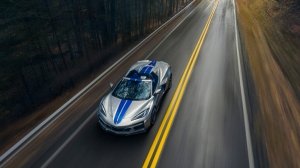
The world’s first hybrid Corvette, the new E-Ray.
Chevrolet
How much power? Chevrolet quotes 655 hp and 595 ft lbs of torque in total. Of that output, 495 hp and 470 ft lbs of torque come from the 6.2-liter LT2 V-8 engine at the rear, which is unchanged from the base Stingray. The electric motor up front provides 160 horses and 125 ft lbs of torque on its own. The combined figures come within 15 hp of the mighty Z06, but, importantly, offer 135 more ft lbs of torque.
The V-8 is still of the traditional sort, while the up-front electric motor pulls from a 1.9 kwh battery pack mounted between the seats. That’s small by EV standards, even tiny for your average plug-in, but the point here isn’t range. The goal is performance, and a heavy battery can be a hindrance. So, the pack here is optimized for quick discharge, driving the motor for acceleration, and then quick recharges with regenerative power coming under braking.
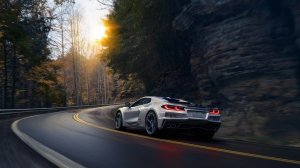
The biggest difference compared to the base Corvette Stingray is acceleration, with the E-Ray covering zero to 60 mph in 2.5 seconds.
Chevrolet
That regen should take some load off of the brakes, but the E-Ray comes with carbon ceramics just the same. To match that extra braking performance, plus the extra power, the E-Ray has extra tire. It rolls on the same, staggered, 20- and 21-inch setup as the Z06, plus features that edition’s flared body contours.
This translates to the E-Ray’s inherently meaner look than that presented by the base Stingray, with only a few subtle badges identifying it as a hybrid. That said, a pair of big, blue stripes can be added to provide a little more differentiation should you care to flaunt it.
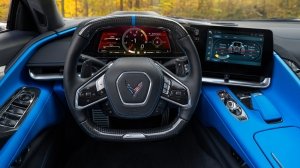
Among the data presented on the digital displays are output information for the engine and electric motor, a graph of power and torque over time, and the electrical system’s level of operating efficiency.
Chevrolet
The biggest performance difference compared to the base Stingray is the acceleration. The hybrid E-Ray makes good use of that electric motor to sprint from zero to 60 mph in just 2.5 seconds. That’s 0.4 seconds quicker than a Stingray with the Z51 package, and 0.1 seconds quicker than even the Z06. Basically, the E-Ray has supercar levels of acceleration, and you can feel it.
I was taken for a few quick laps around the General Motors Milford Proving Ground outside of Detroit, Mich., in the E-Ray, starting with a some runs to 60 mph from a dead stop. The vehicle rockets forward with little fanfare, front tires adding enough pull to keep the car accelerating while the rear tires struggle to find grip. Then, once all four tires have hooked up, it’s a rocket ship. The launch is so fast that it almost feels disappointing when 60 mph is reached; the E-Ray is just starting to hit its stride.
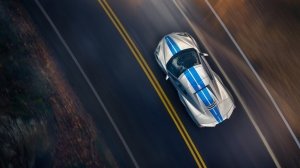
The battery pack is optimized for quick discharge, driving the motor for acceleration, and then quick recharges with regenerative power coming under braking.
Chevrolet
It corners tenaciously, too. The hybrid system adds a little over 200 pounds to the car, which isn’t bad considering the increase in power, but from the right seat it never feels heavy. It still cuts a clean line into the apex of turns and, once the traction control is disabled, is more than happy to light up the rear tires and engage in some proper drifting tomfoolery.
So, no, this isn’t an economy car, as is also evidenced by its cost. At $104,295 for the 1LZ coupe and $111,295 for the convertible, the E-Ray is priced only slightly below the Z06. That might seem like a conflict, but these are two very different model variants. Where the Z06 is happiest on the track, while nervous and agitated on uneven streets, the E-Ray is a comfortable cruiser with manic power and great handling. In Porsche terms, think of the E-Ray as a 911 Turbo S, while the Z06 is more like a GT3 RS.
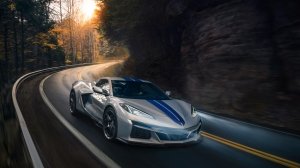
The Corvette E-Ray is priced at $104,295 for the coupe and $111,295 for the convertible.
This hybrid is an interesting addition to Chevrolet’s sports-car lineup, one that genuinely pushes it in a new, premium direction. For buyers who want big acceleration and the big grins that come along with it, but don’t want the day-to-day edginess of the Z06, the E-Ray might just be the perfect Corvette.
Click here to see more photos of the Chevrolet Corvette E-Ray in action.
The hybrid Chevrolet Corvette E-Ray.
Chevrolet
[bsa_pro_ad_space id=15]