
[bsa_pro_ad_space id=14]
Committed students of any stripe are a pretty serious bunch, and it’s a virtual certainty that collectors of just about anything will have amassed a library of books on their preferred subject. Despite the proliferation of online resources, car enthusiasts are known to be bookworms, always consulting printed materials for reference, broadening their knowledge or simply for the pleasure of taking an armchair drive when not actually behind the wheel.
Their shelves might be lined with marque monographs, technical manuals, histories, photo portfolios and even contemporary reviews, all of which can enhance the ownership experience in tangible and intangible ways. One new publication that is required reading for any committed car lover is The Archaeological Automobile by Miles C. Collier, published in 2022 by Collier AutoMedia LLC. In this 392-page volume, the founder of Revs Institute in Naples, Fla., an important automotive museum, research and educational facility, convincingly positions the automobile as the greatest technological artifact of the contemporary world. One could argue that the car, in its finest form, is also the greatest sculpture of our age, but that is a discussion for another time.
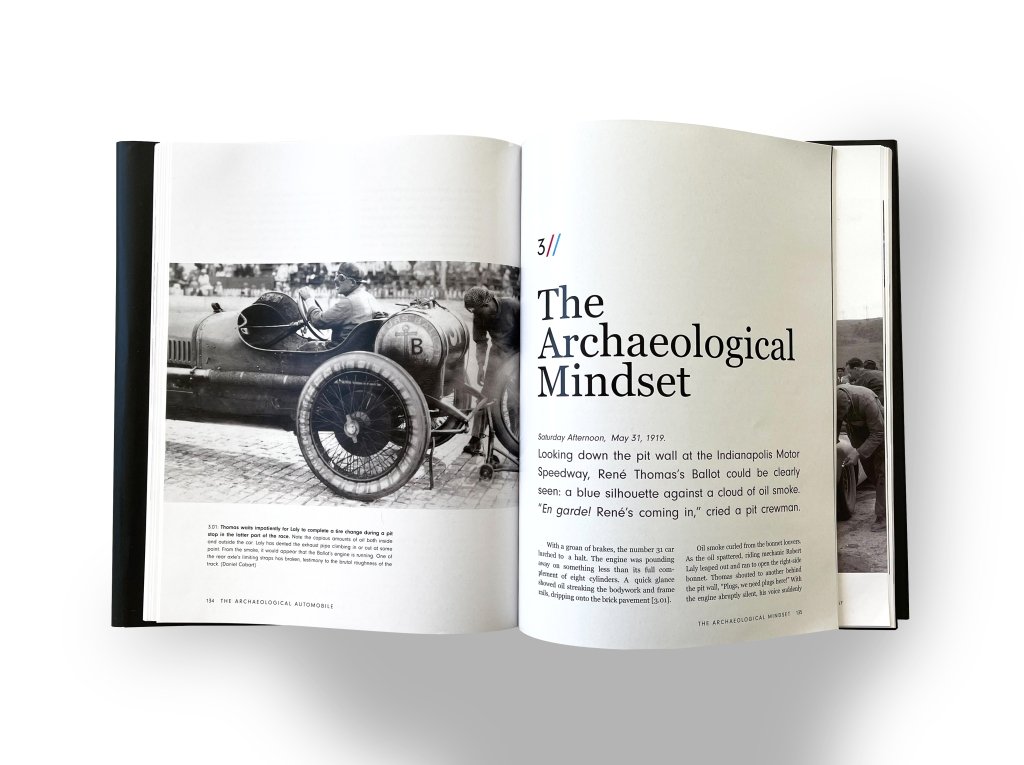
Sections within Chapter Three ponder topics such as “Using the Archaeological Mindset to Work on Automobiles,” “The Fate of All Things” and “The Problems of Replicas.”
Revs Institute
To be sure, the automotive ownership experience is evolving as quickly as is the automobile itself. Even a V-12-powered Italian sports car from the first decade of the 21st century is a relatively straightforward machine when compared to the new computer-cum-motorcars, those rolling digital devices that will surely usurp traditional internal-combustion vehicles in the near future. Given the fast-paced role change of the car, this book considers the significance of past, present and future automobiles from six perspectives.
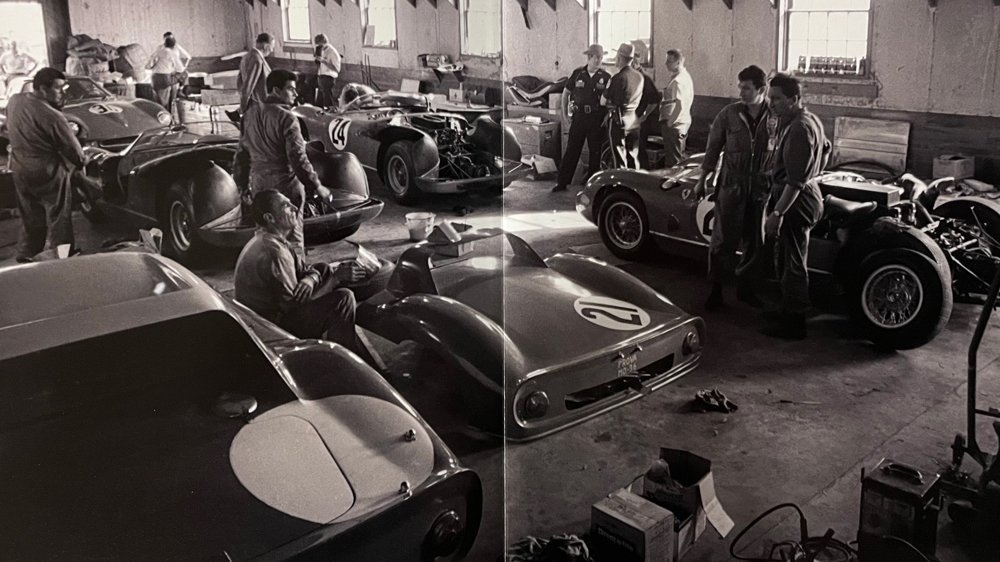
From the book, a photo of Ferrari’s factory team cars receiving last-minute attention at the 12 Hours of Sebring in 1964.
Tom Burnside Photograph Collection, courtesy of Revs Institute.
The section entitled “The Evolution of the Automobile” examines the origins of the horseless carriage, envisioned as a panacea to the pressing need for mass transportation. The spell cast by speed and style ensured the motorcar’s success, and the birth of a new industry that defined world commerce going forward. “The Rise of the Collectible Automobile” explores the appreciation for historic relics as their age distanced them from contemporary cars, how some became icons and how a collector market emerged that made some nearly as valuable as any piece of fine art—painting, sculpture or antiquity—ever to come to auction.
“The Archaeological Mindset” portion takes an Egyptologist’s approach to the restoration of an ancient race car, revealing details as dust and age are brushed away and research fills in the missing pieces to complete a compelling rendition of the original machine. Then, the subsequent “Collecting and the Archaeological Automobile” probes the notion of connoisseurship, a highly charged term that suggests matters of taste, discernment, passion and less laudable attributes that occasionally motivate collectors, such as greed and hubris.
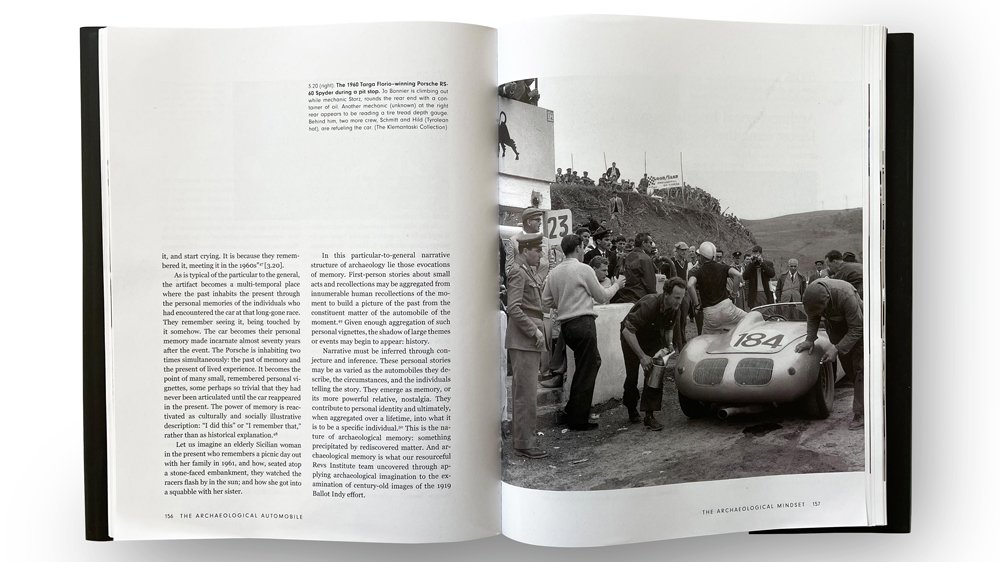
The publication is illustrated with many historic photographs, like this one from the Klemantaski Collection of the 1960 Targa-Florio–winning Porsche RS-60 Spyder during a pit stop.
Revs Institute
An especially relevant section is “Restoring the Archaeological Automobile,” which even suggests that restoration is an inherently fictitious concept. As is often said, “It’s only original once.” But sometimes the restorer must intervene, and a responsible conservator is confronted with numerous and subtle courses of action, occasionally with no single correct answer. Architectural conservators are faced with this all the time; should a Gothic building erected in 1390 and renovated every subsequent century be restored with its impressive Baroque-era facade—or to its original, and far less opulent and significant design? For example, Collier considers the correct way to repaint a 1964 Alfa Romeo GTZ race car in such a manner that respects and replicates the car’s competition history.
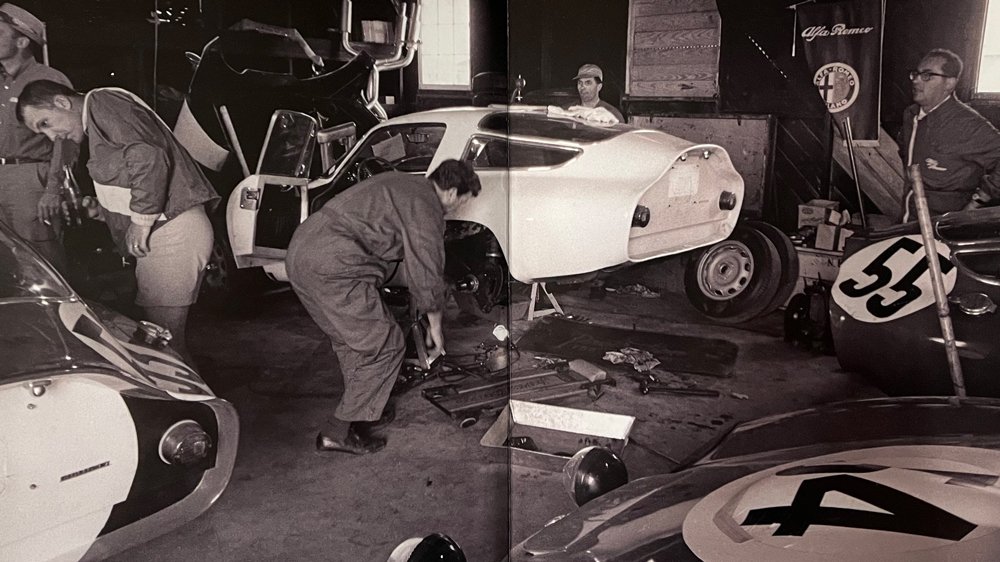
Scuderia Sant’Ambroeus’ Zagato-bodied Alfa Romeos being prepped for the 1964 12 Hours of Sebring, as shown in “The Archaeological Automobile” by Miles C. Collier.
Tom Burnside Photograph Collection, courtesy of Revs Institute.
Finally, “The Archaeological Automobile of the Future” takes a critical look at the challenges of preserving our automotive legacy in light of adverse political agendas, shifting public sentiment, the aging out of specialist restorers and technicians and an unpredictable collector market.
This book is ambitious in its reach, embracing and arguing its subject more comprehensively and convincingly than any I’ve yet read. It will delight lovers of automotive minutiae and equally satisfy philosophical types, posing questions and positing answers at every turn. Basically, it’s an immensely satisfying and worthwhile tome for anyone who has ever wondered about old cars.
Click here for more photos from The Archaeological Automobile by Miles C. Collier.
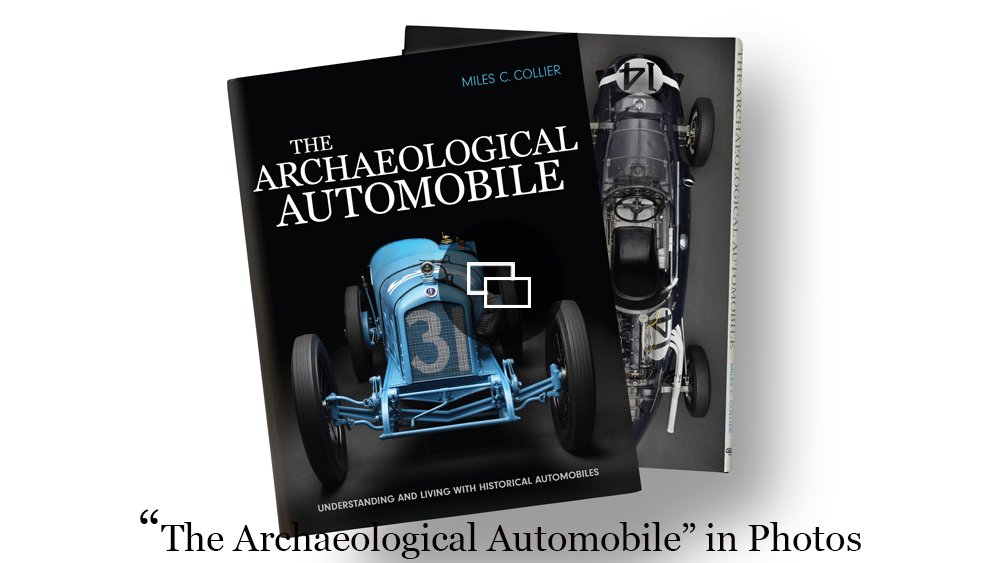
The book The Archaeological Automobile by Miles C. Collier.
Revs Institute
[bsa_pro_ad_space id=15]