
[bsa_pro_ad_space id=14]
The Raging Bull marque has certainly been charging full speed in a year that’s seen many automakers just trying to stay in the ring. This morning, on the heels of announcing a new president and CEO, Automobili Lamborghini has also revealed the latest (and rumored to be last) variant in its highly successful Huracán model line—the new Lamborghini Huracán STO.
The “STO” in the moniker stands for “Super Trofeo Omolagata” and references Lamborghini’s Super Trofeo race series that balances the playing field with one model of car, the Huracán Super Trofeo Evo, the template for this latest release. A homologated—or street-legal version—of its motorsport sibling, the STO features design and performance characteristics that have also been influenced by the Huracán GT3 Evo, a racer that has earned the checkered flag a combined five times at the 24 Hours of Daytona and 12 Hours of Sebring.
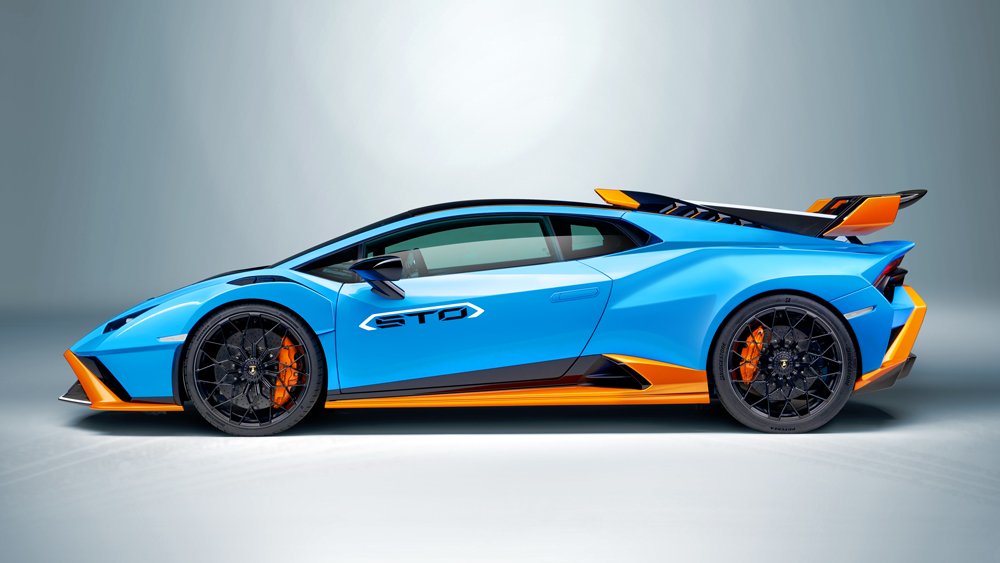
The new Lamborghini Huracán STO.
Photo by Diego Vigarani, courtesy of Automobili Lamborghini S.p.A.
The rear-wheel-drive STO shares the same naturally aspirated V-10 as Lamborghini’s competition cars, an engine that, in this case, has been boosted to produce 640 hp, about 9 hp more than the track-inspired Huracán Performante. And a maximum torque of 417 ft lbs is delivered at 6.500 rpm. With a seven-speed dual-clutch transmission in the mix, the power train makes possible a top speed of 192 mph and the ability to accelerate from zero to 62 mph in 3.0 seconds.
Although the latter performance specs are a touch below that of the Performante’s figures, the STO can come to a full stop from 62 mph in 98.4 feet, 3.3 feet less than required by the Performante. This is due, in part, to the integration of Brembo’s carbon-ceramic brakes developed for both racing and road use, components that improve overall braking efficiency and offer 60 percent greater stress resistance to those on Huracán predecessors. Additionally, new cooling ducts specifically for the brake calipers have been incorporated on the vehicle to mitigate overheating.

The power train makes possible a top speed of 192 mph and the ability to accelerate from zero to 62 mph in 3.0 seconds.
Photo: Courtesy of Automobili Lamborghini S.p.A.
Tipping the scales at a total of 94 pounds less than the Performante, the STO’s dry weight of only 2,952 pounds is made possible by the chassis and body both constructed from aluminum and carbon fiber, the latter comprising the hood and 75 percent of the outer panels. To complement the lightweighting, a host of aerodynamic enhancements include the hood, front bumper and fenders united in one overarching piece. This element is benefitted by new engine-cooling air ducts on top that increase downforce. Also optimizing air movement is a redesigned front splitter and underbody. In addition, the back fender, also sculpted to increase downforce, incorporates a NACA air intake to further assist engine performance.
Most noticeable visually, however, are the STO’s shark-like fin along the back hood and the manually adjustable rear wing. The fin serves to aid in stability while in the turns, where it also works to more effectively channel air to the wing, which can be set in three positions for varying levels of influence. The sum of the aerodynamic parts translates to a 53 percent increase in downforce and a 37 percent improvement in air management compared to the Performante.
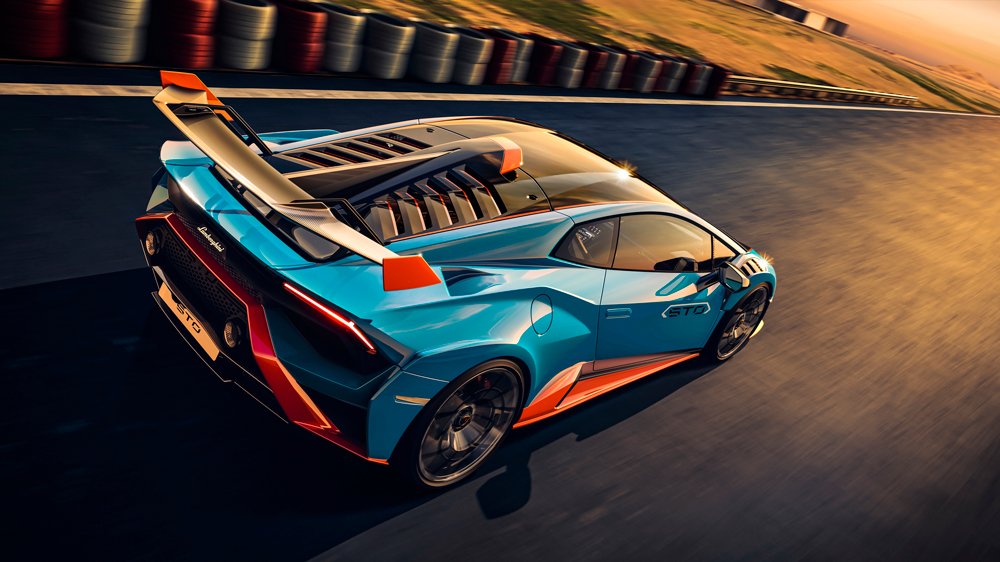
The fin along the back hood aids in stability and more effectively channels air to the wing.
Photo: Courtesy of Automobili Lamborghini S.p.A.
The STO, with rear-wheel steering, has the Evo’s same onboard super-computer-based LDVI system that predicts driver actions based on a variety of inputs and telemetry readings, readjusting every 20 milliseconds. But now, there are three new drive modes: STO for spirited driving under normal conditions; Trofeo, ideal for track; and Pioggia, which translates to “rain” and, as such, is intended for low-friction conditions.
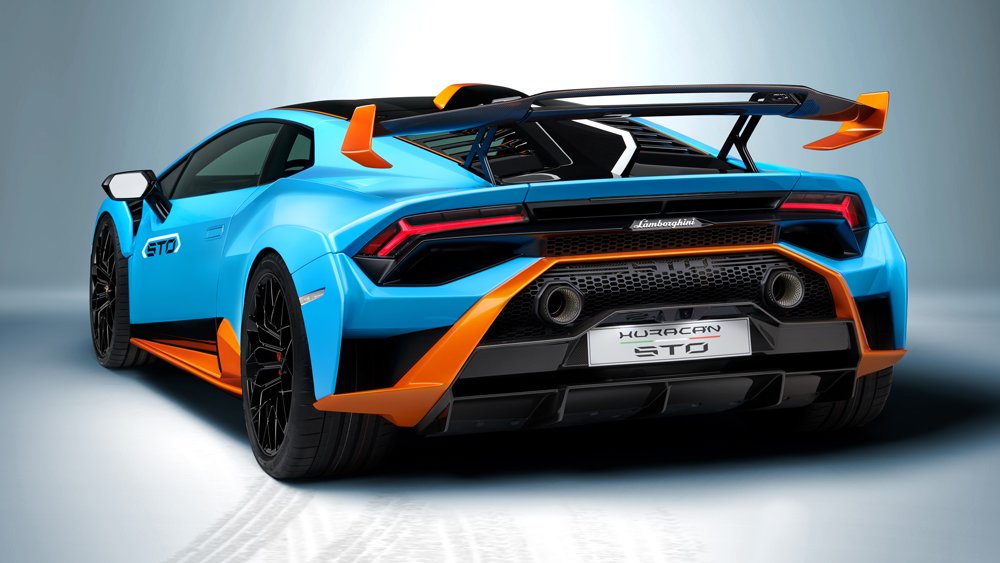
The sum of the aerodynamic parts translates to a 53 percent increase in downforce compared to the Huracán Performante.
Photo by Diego Vigarani, courtesy of Automobili Lamborghini S.p.A.
The cockpit of the car definitely reflects the STO’s racing pedigree with ubiquitous carbon fiber, including the sport seats, door panels and even floor mats. There’s also a comprehensive telemetry display that presents and records all pertinent track data that can be accessed later by an app.
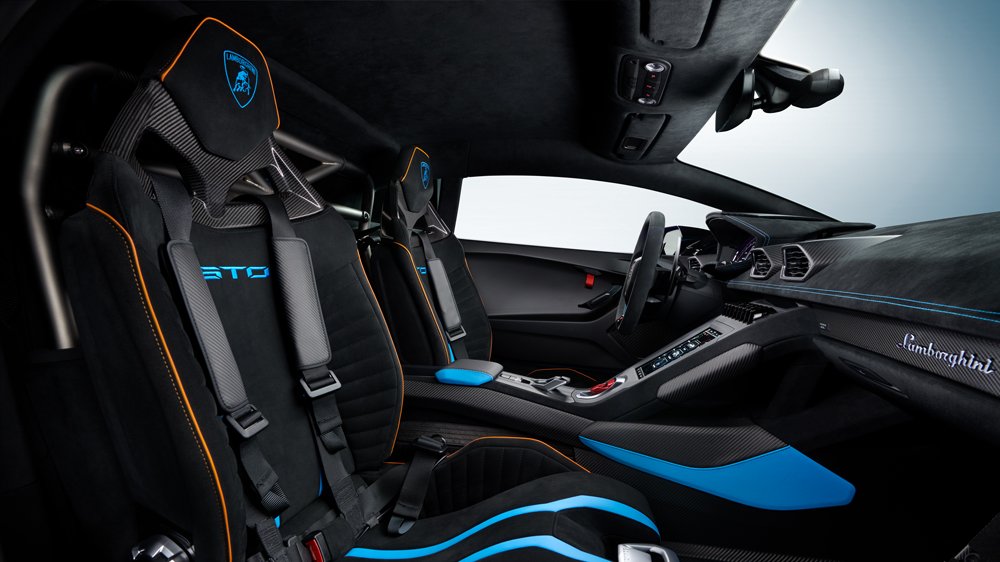
Carbon fiber is used throughout the cockpit, including on the sport seats, door panels and floor mats.
Photo by Diego Vigarani, courtesy of Automobili Lamborghini S.p.A.
Whether or not this is the swan song for the Huracán, a line that has garnered the title of Robb Report Car of the Year multiple times, is yet to be seen. But with Bugatti’s CEO Stephan Winkelmann now stepping in as Lamborghini’s president and CEO concurrently, there’s no reason to believe that the development of new breeds from Sant’Agata Bolognese will slow anytime soon. Pricing for the Lamborghini Huracán STO starts at $327,838, with first deliveries scheduled for spring.
[bsa_pro_ad_space id=15]