
[bsa_pro_ad_space id=14]


 0
0The Suzuki S-Cross has lived like a middle child between the attention-seeking Vitara and Swift, which always commanded more attention. Now the 2023 Suzuki S-Cross prepares to step into the limelight.

What we love
- Fun driving dynamics
- Easy-to-understand driver interfaces
- Huge boot

What we don’t
- Big step up in price
- Safety spec behind the class
- Limited rear seat space
Suzuki has revamped the S-Cross. Although it’s largely the same car under the skin, the 2023 Suzuki S-Cross gets a fresh interior and new, more expressive mini-SUV styling.
Beneath the surface you’ll find the same 1.4-litre turbocharged engine as before, only now it hits the pavement through Suzuki’s AllGrip all-wheel-drive system.
Step inside and you’ll find even more new features with a new 9.0-inch infotainment screen and 360-degree camera, the latter a first for Suzuki Australia.
As with so many new cars, price has been revised upwards, though the mechanical changes at least offset part of the increase. But is it enough to keep the S-Cross competitive in a packed small SUV class?
How much does the Suzuki S-Cross cost in Australia?
The 2023 Suzuki S-Cross range comprises two models: officially called the S-Cross AllGrip and S-Cross Premium.
Pricing for the entry-level S-Cross starts from $40,490 rising to $44,490 for the S-Cross Premium, both before on-road costs.
Both variants are powered by a 1.4-litre turbo petrol engine (shared with the Suzuki Vitara and Swift Sport) making 103kW and 220Nm. A six-speed automatic is standard, as is switchable all-wheel drive with Auto, Sport, Snow and Lock settings (more on those further down).
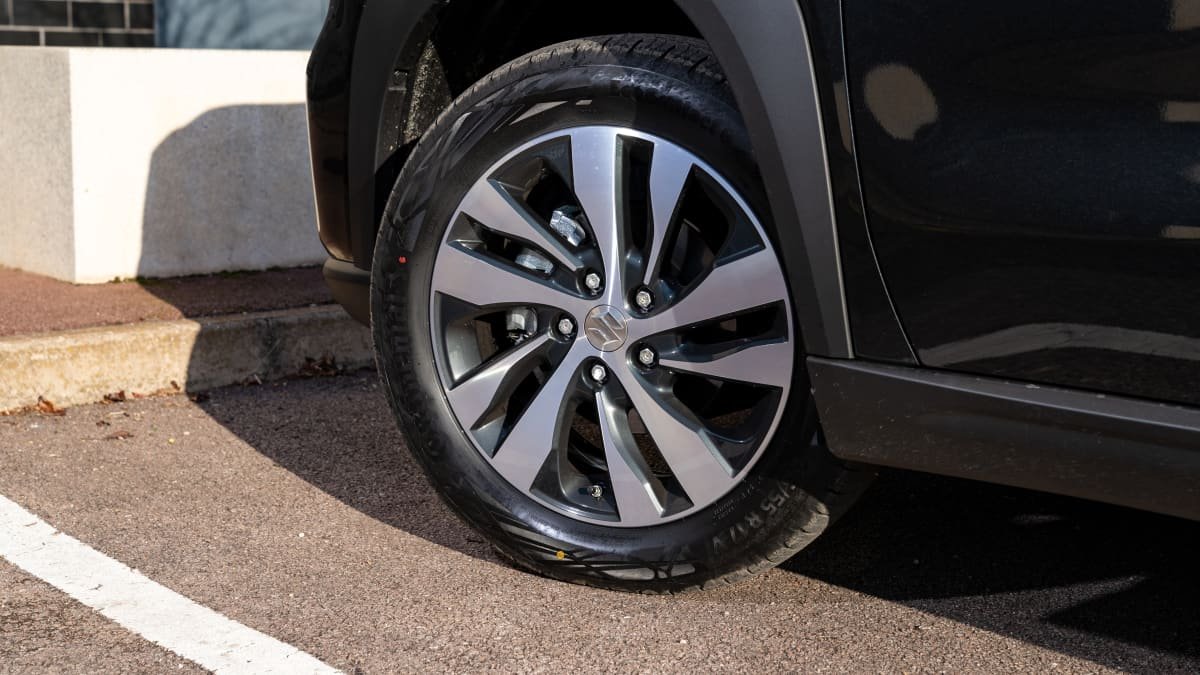
The base S-Cross ships with cloth seat trim, 17-inch alloy wheels, adaptive cruise control with speed limiter, keyless entry and start, automatic LED headlights, rear privacy tint, dual-zone climate control, 7.0-inch infotainment and more. Stepping up to the Premium adds a panoramic sunroof, leather and cloth seat trim, a 9.0-inch infotainment system with wireless Apple CarPlay, polished alloy wheels, and a 360-degree camera.
While tech like the 360-degree camera and upsized (and definitely improved) infotainment are good, the S-Cross now sits some $7000 above an all-wheel-drive Vitara with the same turbo engine, and in top spec is $12,500 more expensive than the outgoing (albeit two-wheel drive) S-Cross Prestige.
| Key details | 2023 Suzuki S-Cross |
| Price | From $40,490 plus on-road costs |
| Colour of test car | Jaundice yellow |
| Options | Option pack – $XXXX – Pack item one – Pack item two – Etc. Standalone option – $XXXX |
| Price as tested | $XX,XXX plus on-road costs |
| Drive-away price | $XX,XXX |
| Rivals | Hyundai Kona | Mitsubishi Eclipse Cross | MG ZST |
How much space does the Suzuki S-Cross have inside?
If you’re familiar with the old S-Cross, or any number of other Suzuki models, you’ll easily spot the family resemblance inside the new S-Cross.
The dash design is largely carried over; however, the panel that faces the passenger has a new stitched crashpad with a soft-touch insert, and the centre stack has been completely reconfigured to accommodate the larger infotainment screen. The air vents have been moved down, and the screen sits higher and is easier to read.
A new face for the instrument dials and a new colour display between the analog tacho and speedo have also been added, and seat trims have been revised. The cloth trim in the S-Cross is nice enough, but the leather and fabric in the S-Cross Premium is a little more contemporary than the old S-Cross’s mix of real and faux leather.
There is still plenty of hard plastics, on the top of the dash and tops of the doors, but places you’re likely to rest your elbow are padded. Even with these solid plastic finishes, the cars we drove at launch felt well screwed together with no flimsy or loose parts and no rattles.
The driver and front passenger get decent space. The seating position is upright affording good outward visibility, but the seat height isn’t so low that you need to drop into it. Slim front pillars are great for visibility too.
Dual-zone climate control is standard, with an easy to use push-button panel and knobs for temperature control. The centre console houses two cupholders and a narrow lidded bin, plus there’s a small space for keys or wallets just ahead of the gear selector.
The rear seats aren’t as spacious as the fronts. If front occupants concede some space leg room is decent, but head room is slim for taller occupants. Think of the second row as ideal for kids and just-in-case transport for adults. There are no air vents or USB power for rear occupants either.
Boot space remains the same as before with a generous 430L of space. A frontrunner in the small SUV class.
With the rear seats folded there’s up to 1230L available. A dual-position boot floor that can also be propped at an angle adds a touch of versatility too.
| 2023 Suzuki S-Cross | |
| Seats | Five |
| Boot volume | 430L seats up 1230L seats folded |
| Length | 4305mm |
| Width | 1785mm |
| Height | 1585mm |
| Wheelbase | 2600mm |
Does the Suzuki S-Cross have Apple CarPlay?
Two slightly different infotainment systems occupy the middle of the dash in the 2023 Suzuki S-Cross.
In the case of the entry-level S-Cross, there’s a 7.0-inch touchscreen display equipped with satellite navigation, AM/FM/DAB radio, Bluetooth, and wired smartphone connectivity for Apple CarPlay and Android Auto. This screen is easy to use and graphically simple, although its overall polish is let down a little with huge black bezels around the screen and no knobs for volume or tuning.
The S-Cross Premium steps things up slightly with a 9.0-inch screen and a more integrated look with smaller bezels. The system is equipped with all the features of the base model, plus adds wireless connectivity for Apple CarPlay (but not Android Auto, which is wired only). A multi-angle 360-degree camera is also fitted to the Premium in place of a reverse camera only on the base model.
Suzuki’s interface also allows access to functions like trip computer details. Voice recognition is also equipped, but requires a set commands (not conversational ones) and on test, even closely following the provided prompts, the system had a fairly significant failure rate.
Is the Suzuki S-Cross a safe car?
Despite this new S-Cross being largely based on the underpinnings of its predecessor, the previous ANCAP rating does not carry over. As such, the 2023 Suzuki S-Cross is currently unrated at the time of writing.
Standard safety equipment includes autonomous emergency braking, lane-departure warning, weaving alert (also known as fatigue detection), blind-spot monitoring, rear cross-traffic alert, front and rear park sensors, plus two ISOFIX and three top-tether child seat mounts.
Newer vehicles to market have also added tech like lane-centering and lane-keep assist, more advanced AEB with intersection intervention, and a centre airbag to prevent occupants from clashing in the event of a collision, but for now the S-Cross goes without these more advanced safety features.
| 2023 Suzuki S-Cross | |
| ANCAP rating | Untested |
Suzuki covers all cars in its current range with a five-year, unlimited-kilometre warranty.
The S-Cross is also offered with a five-year capped-price service program. Intervals are a little on the short side at 12 months or 10,000km (where most rivals allow up to 15,000km), and the first five visits to a Suzuki dealer are priced at $329, $429, $329, $529 and $329 respectively.
We weren’t able to obtain an insurance quote for the 2023 S-Cross (with this review compiled before the car officially reached market); however, looking at the 2022 S-Cross, insurance starts from $1221 per year. It’s worth noting that while the two cars are similar, the higher purchase price of the 2023 S-Cross is likely to impact on its premiums.
Our insurance quote is based on a comparative quote for a 35-year-old male driver living in Chatswood, NSW. Insurance estimates may vary based on your location, driving history, and personal circumstances.
| At a glance | 2023 Suzuki S-Cross |
| Warranty | Five years, unlimited km |
| Service intervals | 12 months or 10,000km |
| Servicing costs | $1087 (3 years) $1945 (5 years) |
Is the Suzuki S-Cross fuel-efficient?
Fuel consumption for the 2023 Suzuki S-Cross has risen slightly compared to its front-drive predecessor, but still sits at a respectable 6.2L/100km as an official claim.
Suzuki’s launch drive made it hard to get an accurate gauge on how that might translate in the real world. Plenty of slow-speed dirt road driving and short drive loops in different cars made it difficult to get a bigger picture. One 40km stretch returned an 8.2L/100km figure, but also included a stink at 40km/h trekking up a dirty road – probably not likely to be the daily use case for most owners.
| Fuel Useage | Fuel Stats |
| Fuel cons. (claimed) | 6.2L/100km |
| Fuel cons. (on test) | 8.2L/100km |
| Fuel type | 95-octane premium unleaded |
| Fuel tank size | 47L |
What is the Suzuki S-Cross like to drive?
There’s a way Suzuki cars drive. Almost everything in the range feels light on its feet and eager to turn in, and the new S-Cross is no different.
Some of that lightness translates into a tinny feel when you shut the doors, or manifests in the plasticky interior, but tip the new S-Cross into a corner and all is forgiven. The steering feels deftly connected, and while it’s light overall, it’s responsive and accurate. Something not every SUV in the class can boast.
The 1.4-litre turbo four-cylinder engine is really nice for the package. It’s nimble rather than flat-out fast, and it has enough torque in reserve for a quick burst of rolling acceleration around town.
You have 103kW and a healthy 220Nm at your disposal. That puts it somewhere in the middle of the pack. In a Kia Seltos GT-Line you get 130kW/265Nm, in a non-hybrid Honda HR-V there’s 89kW and 145Nm, and if you were considering a new MG ZST you’ll find a similar 115kW and 230Nm.
If you push hard the engine will kick up some noise, but it’s not too harsh or loud. Perhaps most surprising of all is how quiet and settled the S-Cross feels at 100km/h. Sure, there’s some road and wind noise, but the S-Cross puts plenty of other cars in the class to shame with its composure.
Ride quality is mostly decent. It’ll soak up bumps and dips around town, but big hits will shudder through the cabin. It’s here that you can feel the little Suzuki doesn’t match the composure of its rivals.
Our introduction drive covered open road, gravel roads, and interestingly a tame four-wheel-drive course derived from a motorcars circuit.
The multi-mode all-wheel-drive system offers Normal, Sport, Snow and Lock modes, and these run from predominantly front-wheel drive with rear intervention on demand in Normal mode, to a 66:33 split in Snow mode, with the idea being a front bias helps keep things on the straight and narrow in icy conditions. Snow also tightens the reins in stability control, but leaves traction control loose to provide some bite in tread-clogging snow.
Lock mode does as it suggests and locks the all-paw system into a 50:50 split, while Sport mode adds in rear intervention, loosens off stability control, and modifies transmission behaviour to be more responsive.
Surprisingly, on the off-road circuit the little S-Cross battled through without breaking a sweat. With drive locked it was easy to keep moving, even with a wheel lifted. It’s no hardcore off-roader, and lacks locking diffs or significant ground clearance (although 175mm of clearance is not bad for a little SUV, especially compared to the 185mm on offer in the Vitara).
We scraped a few times, and wouldn’t tackle anything more than a muddy country road or a cross-paddock carpark, but it’s nice to know there’s some support in case you find yourself off groomed roads.
| Key details | 2023 Suzuki S-Cross |
| Engine | 1.4-litre four-cylinder turbo petrol |
| Power | 103kW @ 5500rpm |
| Torque | 220Nm @ 1500–4000rpm |
| Drive type | All-wheel drive |
| Transmission | Six-speed torque converter automatic |
| Power to weight ratio | 80kW/t |
| Weight | 1290kg |
| Spare tyre type | Space-saver |
| Tow rating | Not provided |
| Turning circle | 10.8m |
Should I buy a Suzuki S-Cross?
Suzuki has always offered cars that provide fun dynamics and lightweight frugality, but its specialist approach to compact models makes Suzuki somewhat an underdog among brands with more diverse model ranges.
There’s no doubt that, at its core, the S-Cross is a fun little car with some interesting all-road capabilities. It’s in a tough segment, though, and you don’t have to look hard to find rivals with more power, more equipment, better safety credentials, and plusher interiors.
That may have been forgivable if Suzuki had managed to keep prices in the $30,000 realm, but the blunt pencil used to price up the revised S-Cross range isn’t likely to do it any favours.
For a small niche of Suzuki faithful, the S-Cross will appeal with its big boot and updated styling, but for most small SUV shoppers, other brands offer more and often for less.
Read more about Kez Casey 
[bsa_pro_ad_space id=15]