
[bsa_pro_ad_space id=14]

 0
0Audi blends electrification, performance, and controversial SUV-coupe styling together to impressive effect with the 2022 Audi E-Tron S Sportback.
- Interior is spacious in every direction
- Absolutely unruffled, even at maximum attack
- Nicely integrated driver assist tech
- Virtual mirrors aren’t a safe solution
- Power consumption is high
- Interior storage needs a rethink
As the jewel in the E-Tron crown, the 2022 Audi E-Tron S Sportback blends impressive Audi Sport performance with a set of more commanding visuals – all while sipping nary a drop of petrol or diesel.
Audi’s expanding E-Tron sub-brand has seen sleek E-Tron GT four-door coupes and a range of SUVs added overseas, but in Australia the original E-Tron SUV range still flies the flag – at least for the time being.
The E-Tron itself comes in a choice of two body types, a regular SUV or a fastback coupe-style Sportback like that seen here. While the range kicks off from $139,900 plus on-road costs, head to the flagship and the ask rises to $168,400 for the E-Tron S SUV or $175,400 for the E-Tron S Sportback seen here.
The upsize brings an appreciable lift in performance, as you’d expect, with peak power of 370kW (in Boost mode) compared to the 230kW the range starts at.
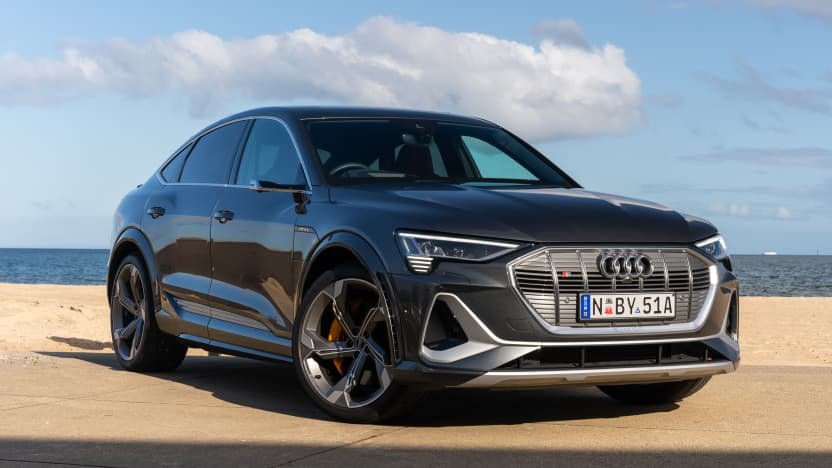
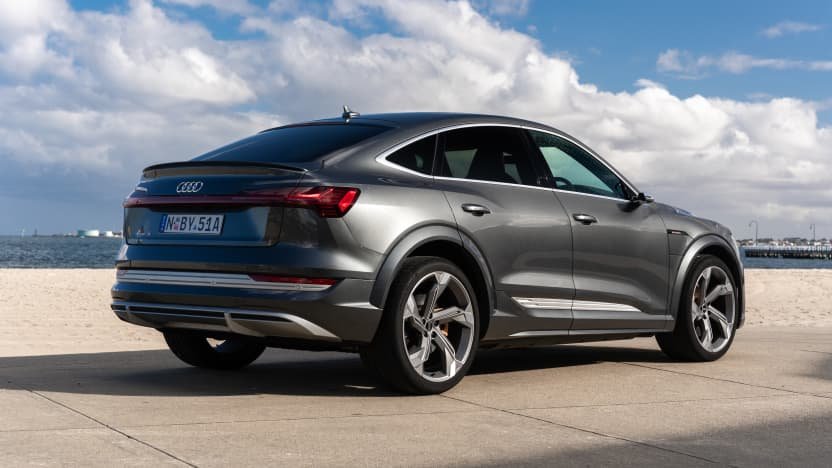
The S overhaul also brings some unique styling touches, with wider wheel arch extensions, S bumpers, lowered suspension, and 21-inch (or optional 22-inch) Audi Sport alloy wheels.
| Key details | 2022 Audi E-Tron S Sportback |
| Price (MSRP) | $175,400 plus on-road costs |
| Colour of test car | Daytona Grey |
| Options | Sensory Package – $9600 – Digital Matrix LED headlights – E-Tron logo puddle lamps – Soft-close doors – Heated outboard rear seats – Rear door sunshades – Extended nappa leather trim package for upper and lower dash Virtual exterior mirrors – $3500 Carbon-fibre interior inlays – $1850 22-inch Audi Sport alloy wheels – $1600 without wireless phone charging – $481 without electric steering column adjustment – $650 without tyre pressure monitoring system – $494 |
| Price as tested | $190,325 plus on-road costs |
| Rivals | BMW iX xDrive50 | Tesla Model Y Performance | Porsche Taycan 4S Cross Turismo |
Bridging the gap between the old world of automotive and the new, the E-Tron’s interior gets some things very right, while other elements leave room for improvement.
In terms of space, the E-Tron Sportback answers the call. Even with its sloping fastback profile, there’s ample space for occupants, both front and rear.
While the roof line is a touch lower than its SUV counterpart, particularly in the rear, adult passengers can still get in and out without ducking. Once inside, there’s room to stretch out in all directions.
The dash design isn’t vastly different from other new-generation Audi models and presents well. It looks high-tech and feels high-quality with interesting and premium materials used throughout.
The commanding gear selector arm dominates the centre console, but it’s only the end closest to the driver that moves. It’s a simple flick back and forth action to select the direction of travel, and I reckon it works intuitively and easily.
Further back, Audi’s storage options are plentiful, but the E-Tron still hasn’t quite mastered the idea that you might want to stash your phone and wallet somewhere quickly, with uncovered cupholders in a deep recess making them fiddly to use.
Interested in this car? Provide your details and we’ll connect you to a member of the Drive team.
A secondary screen to control the climate system eats further storage space, and even the centre console and door bins fall short. Given the Audi’s flat floor and voluminous interior, the lack of abundant and clever storage grates.
Also unmissable within the interior are the digital rear-view mirror screens. Instead of traditional mirrors, a camera on each side of the car feeds back a rear-view video feed.
For me, the screens, mounted almost at a right angle to the view they show, seem counterintuitive. No doubt they get better to use over time, but they present a few problems.
The screen orientation is one, and your brain has to map how a side-on image translates to a rear view each time. The other is the focal depth, with the need to refocus close up, and not into the distance like a real mirror.
Finally, for parking, the view is limited, and moving your head doesn’t change the field of view, making close manoeuvres, and even some merges, a nerve-wracking guessing game.
A real swing and a miss from Audi on these – but they’re optional, so I’d suggest leaving this box unchecked.
Standard equipment covers features like four-zone climate control, 30-colour ambient lighting, electrically adjustable heated front sports seats, keyless entry and push-button start, and privacy tinted rear glass.
At present, due to component shortages, the E-Tron S goes without a powered steering column and wireless phone charging. Buyers are advised to check with their dealer regarding the specifications of a particular vehicle.
Boot space is wholly practical, with 555L to the rear seats. That’s 45L down on the E-Tron SUV, but not enough that you’re likely to miss it. Up front there’s an extra 60L of storage space under the bonnet for cable storage and the like.
With seats folded there’s 1594L, and the tailgate is electrically operated, with gesture control, to open with the wave of a foot under the bumper.
| 2022 Audi E-Tron S Sportback | |
| Seats | Five |
| Boot volume | 555L seats up 1594L seats folded 60L under bonnet |
| Length | 4902mm |
| Width | 1976mm |
| Height | 1615mm |
| Wheelbase | 2928mm |
Infotainment and Connectivity
Three interior displays, for infotainment, climate and instruments, set the E-Tron range up with the right high-tech attitude.
The main 10.1-inch infotainment display features haptic ‘click’ feedback as confirmation of pressing a function, and Audi’s simple tile interface offers easy access to the car’s many functions.
As well as accessing the vehicle various systems, the infotainment system comes loaded with wireless and wired Apple CarPlay, wired Android Auto, 3D digital native maps, and digital radio. Access to connected services via the car’s own dedicated SIM allows info like weather and fuel prices to be displayed from the infotainment system, status, charge and preconditioning via a smartphone app, and destination entry from your phone to your car.
Lower down in the console, an 8.6-inch display keeps the same look and functionality, but can be used to operate the climate control, access shortcut functions, and functions as a touch tablet for handwritten inputs.
Ahead of the driver is a 12.3-inch digital display that can be configured myriad ways, including S-specific sports cluster displays. A head-up display also makes it easy to keep an eye on vital functions.
Overall, the system is easy to get the hang of, and while there are plenty of menu options to explore, they’re set out logically.
Finally, a 16-speaker Bang & Olufsen sound system delivers strong audio performance, if not perhaps straight as concert-hall-clear as some of Audi’s more high-end B&O systems.
The E-Tron S is unrated by ANCAP; however, the physically similar regular E-Tron range carries a five-star ANCAP rating from 2019. It’s not hard to imagine the structure and safety system for the high-performance model would behave similarly.
The E-Tron S range comes equipped with autonomous emergency braking with pedestrian detection (up to 85km/h) and intersection assist (up to 10km/h), eight airbags, adaptive cruise control with stop-and-go and traffic jam assist, active lane assist, blind-spot monitoring, rear cross-traffic assist, 360-degree camera, collision avoidance assist, and safe exit assist.
In practice, features like Audi’s adaptive cruise control and lane assist work well. Operating naturally and working with the driver rather than against them, the system is co-operative and can take some of the load off, particularly on those longer and less involving stints behind the wheel.
With a starting sticker from $175,400 plus on-road costs, the E-Tron S wedges itself in between the $174,900 BMW iX xDrive50 and the $180,400 Porsche Taycan 4 Sport Turismo. But whereas the E-Tron S claims a relatively tame 5.1-second 0–100km/h time matching the Porsche, it’s behind the iX at 4.6 seconds. In Boost mode, however, this drops to a more scintillating 4.5 seconds.
There’s some rare air in the performance EV market, though it’s set to become an increasingly busy space. Tesla’s Model Y Performance shows how cheap they can be, with 3.7-second 0–100km/h potential and starting at just over $100K.
Owners are covered by a five-year warranty with no kilometre cap, while the high-voltage battery is covered for eight years or 160,000km. Servicing is complementary for the first six years of ownership, with intervals set at 24 months or 30,000km.
Subscription to the Chargefox public charging network is also included for six years.
| At a glance | 2022 Audi E-Tron S Sportback |
| Warranty | Five years / unlimited km |
| Service intervals | 24 months or 30,000km |
| Servicing costs | Complimentary (6 years) |
| Energy cons. (claimed) | 26.0kWh/100km |
| Energy cons. (on test) | 33.6kWh/100km |
| Battery size | 86.5kWh, net |
| Driving range claim (ADR) | 418km |
| Charge time (11kW) | 8h 30m |
| Charge time (50kW) | 1h 31m (0–80%) |
| Charge time (150kW max) | 30m (20–80%) |
Audi’s claimed energy consumption for the E-Tron S Sportback is 26.0 kilowatt hours per 100km, which isn’t exactly frugal in the EV realm, but that massive power potential is no doubt part of the reason for this.
On test, the car I drove sat closer to 40kWh/100km during most of my commuting week (where theoretically an EV should be more efficient given its ability to harvest power in stop-start driving). After a weekend of highway stints and more open driving, this averaged out to 33.6kWh/100km.
That meant Audi’s claimed 418km was hard to reach, with the distance to empty readout showing well under 300km on a full charge for most of our time. It’s worth noting that’s using the car with no view to hypermiling or running with comfort features turned off, but disappointing nonetheless.
Given the E-Tron S already starts from a very strong base in the regular E-Tron, how much better can the S version get? Well, disappointingly, not much better. That’s not an indictment on the S per se, more a commendation of the base cars.
Is it rapid? Undeniably. Does it feel it? Actually, no.
As is so often the case with Audi’s S vehicles, the E-Tron S plays a subtle hand – swift but still very refined. To the point that you can almost forget how potent the E-Tron can be.
It’s a feeling amplified by a, let’s say, stable feeling off the line. Whereas some electric vehicles blur the scenery and hurl you into your seat, the E-Tron is gentler off the line.
That moment of moderation is more noticeable outside of the car’s Dynamic mode, which sharpens up reactions and unlocks the full 370kW and 973Nm boost mode, allowing the triple-motor system to run at full potential.
It’s this same three-motor system that gives the E-Tron surprisingly adept handling nous.
From a soft air-spring ride on freeways and firm but forgiving leeway on city streets, the E-Tron S buttons down and stays level and controllable as roads become twistier and the driver more focussed.
The trick twin-motor rear axle provides the kind of torque vectoring rarely seen outside of supercars (and is something not even Porsche has an answer for yet). Immediate power shifts from side to side keep the handling nimble and fun – albeit very controlled and tidy, rather than obnoxious and loutish.
Actually, it tries, but there is a limit and tyres will betray their objection to keeping cornering forces in check. Not in a tail-out, sliding, power-oversteer moment, but more in a squealing and stuttering of traction on the limit.
The fly in the ointment is a steering wheel that feels incredibly light, even in its heaviest, sportiest setting. While the front wheels track true, the isolation from the road creates something of a remote, video game effect.
Stand hard on the brakes and the 2.65-tonne E-Tron S pulls up impressively. That’s without exotic carbon-ceramic rotors, but instead 399mm front rotors clamped by six-piston callipers (and 350mm rotors at the rear).
Under lesser brake applications, regen braking can harvest up to 270kW, meaning the rotors themselves are really secondary to the system’s performance most of the time.
| Key details | 2022 Audi E-Tron S Sportback |
| Engine | Three asynchronous electric motors |
| Power | 150kW front electric 2 x 130kW rear electric 320kW combined, 370kW boost mode |
| Torque | 808Nm combined, 973Nm boost mode |
| Drive type | All-wheel drive |
| Transmission | Single-speed automatic |
| Power to weight ratio | 120kW/t, 139kW/t boost mode |
| Weight (tare) | 2655kg |
| Tow rating | 1800kg braked, 750kg unbraked |
| Turning circle | 12.2m |
Gone are the days when high-performance automobiles came with compromises that made them uncomfortable or unlivable. As the E-Tron S proves, you can have wild performance and room for the whole family easily.
But that all-round capability does still come at a cost. In this case, the S lacks that spine-tingling edge that usually defines a sports car, and often feels like a normal E-Tron, just faster.
It takes dedication to unlock the handling advantages and slingshot performance potential of the tri-motor E-Tron S, which makes the engineering effort feel almost invisible most of the time.
So, the 2022 E-Tron S Sportback passes the grade as an excellent Audi SUV, but for the performance-oriented, the low-slung RS E-Tron GT might be the one to wait for.

Insurance from
$1,610/yr
Estimate details
Read more about Kez Casey 
[bsa_pro_ad_space id=15]