
[bsa_pro_ad_space id=14]
- Doors and Seats
- Engine
- Engine Power
- Fuel
- Manufacturer
- Transmission
- Warranty
- Ancap Safety

Our long-term test with the Hyundai Ioniq EV comes to an end, and despite the raft of negative commentary around electric vehicles, Trent Nikolic finds out that it’s an easy thing to live with day-to-day.
- Compact exterior size works beautifully around town
- Interior is spacious, comfortable and user friendly
- General driving experience is excellent
- If you can only have one car, the range won’t be long enough for some
- Range drops away on freeway with accessories running
- Entry price remains an issue for some would-be buyers
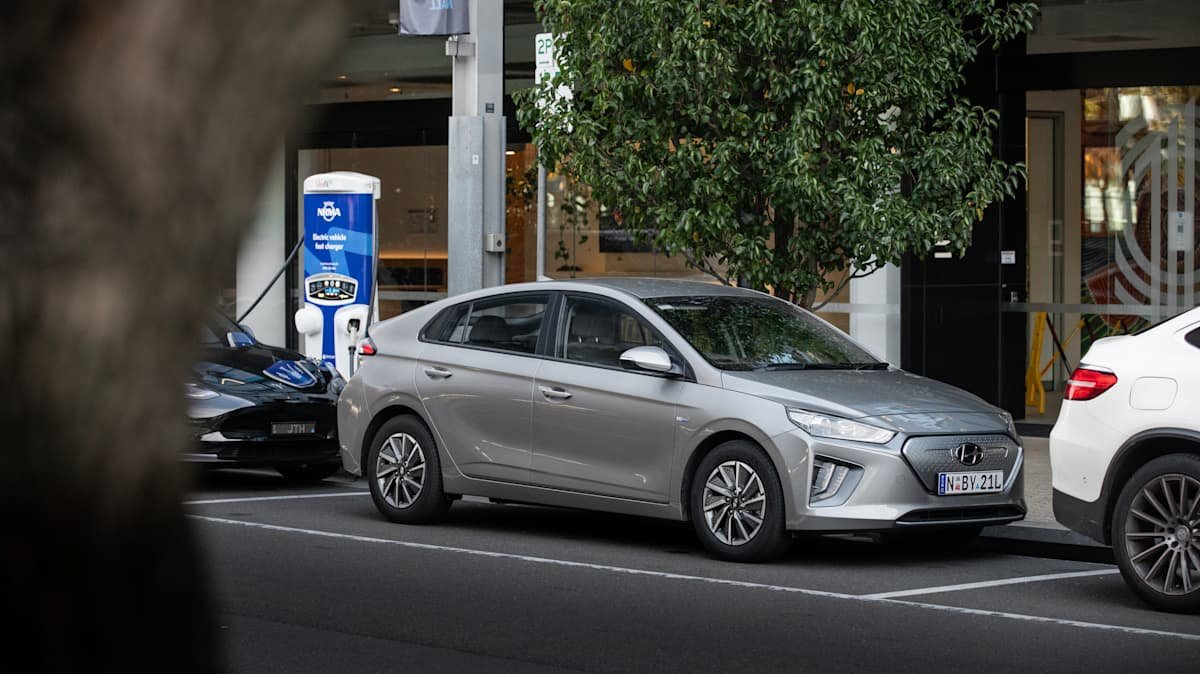
The COVID-19 pandemic has put the brakes on many things, not the least of which is the trivial matter of being able to extensively test cars the way we would ideally like to. I use the word trivial, because people around Australia are doing it really tough, and we don’t want to detract from that. We have however, done as much and the best that we can, within the rules and regulations, but we haven’t been able to venture as further afield as often as we would have liked.
One reader commented that they would like to see us take an interstate run for example, and we weren’t able to report back to you on that. We’ll get back into an EV for just that purpose as soon as we can, though.
Our time with the 2021 Hyundai Ioniq EV Elite didn’t quite wrap up the way we had planned then, but we still got to grips with the increasing practicality of ‘owning’ an electric vehicle in the real world. Our previous updates detail some of the more specific aspects of the energy usage and charging information, so we’ll take a more general look at our time with the Ioniq here.
| 2021 Hyundai Ioniq EV Elite | |
| Engine | Electric |
| Power and torque | 100kW/295Nm |
| Transmission | Single-speed automatic |
| Drive type | Front-wheel drive |
| Kerb weight | 1475kg |
| Boot volume | 355L/1417L |
| Turning circle | 10.6m |
| ANCAP safety rating | Five-star (tested 2018) |
| Warranty | Five years/unlimited km |
| Motor count | Single |
| Battery size | 38.3kWh |
| Driving range | 311km (WLTP) |
| Charging time | 80 per cent capacity in 57 mins on a 50kW fast-charger |
| Tow rating braked, unbraked | Unrated |
| Length/width/height | 4470/1820/1450mm |
| Main competitors | Hyundai Kona, Nissan Leaf, MG ZS EV |
Before I get to the car specifically though, I’ll address some commentary that seems to be a recurring theme whenever we test an electric vehicle. It’s certainly been a recurring theme in the comments section of the Ioniq updates.
First, no one is forcing you to buy an electric car. Nor will they be. Even if there is a mandate that a manufacturer can only sell electric cars beyond a certain date, you can keep driving whatever you currently own, or buy a second hand car/4WD/dual cab/van/SUV with a petrol or diesel engine.
Second, I know this might sound strange to some of you, but I am patently aware that plenty of Australians don’t have access to a garage or off-street parking. I haven’t always had that access myself, and I’m aware that plenty of people don’t. I’m also aware that in those cases, charging at home overnight isn’t possible. Therefore, reference point one above. I’m no electric vehicle fanboy either, not at all, in fact I’ve found myself constantly reporting that until charging infrastructure is vastly improved, ownership is problematic for large sections of the population in this country.
Third, I wrote something about this point in the last update, and I’ll make mention of it again here. There are SUVs that supposedly tow 3000kg or 3500kg. In the real world, they don’t actually tow that weight too well. There are vehicles of all shapes and sizes that use two or three times their ADR fuel claim when you test them as they are meant to be driven. Further, there are vehicles that claim 0-100km/h times you can’t match in the real world, or braking performance you can’t match in the real world. And yet, none of those vehicles cop the same torrent of abuse as an electric vehicle that either doesn’t have enough range to satisfy the zealots or can’t match its claimed range in the real world.
The point above is why, in just about every electric vehicle test I’ve ever written, I’ve added something along the following lines: Don’t buy one if it doesn’t suit your use case. If an electric vehicle doesn’t work for you, no problem, don’t buy one. If you’re a one-car family, an electric vehicle probably isn’t the right choice either. If you regularly travel long distances into regional areas, an electric vehicle probably isn’t the smartest choice for you.
And yet, the predictable commentary gets tossed up just about every time, aiming barbs at electric vehicles. No such issue though, if I was to write that a 911 GT3 RS isn’t the smartest thing to drive on a potholed B-Road out to your farm every weekend. If you’re going to regular track days though…
Finally, I’ll write it here one more time. No one is forcing you to buy an electric vehicle. There are plenty of credible and affordable alternatives and they are available and will be available to buyers who don’t suit an electric vehicle. Or don’t want an electric vehicle, because that’s fine too.
Onto the Ioniq then, which, price aside, proved to be a practical run around with few negatives. Yes, more range would be handy. Yes, more public charging infrastructure would be helpful, yes faster charging times would be ideal. And yes, price parity, or sharper pricing more specifically, would make electric vehicles like the Ioniq more accessible to more Australians.
Get a great deal today
Interested in this car? Provide your details and we’ll connect you to a member of the Drive team.
At the time of writing, our Electric Elite starts from $49,970, before on-road costs, so it’s a fair wedge more expensive than a comparable Hyundai i30 Elite sedan for example, which starts from $31,190 before on-road costs. When you speak to electric vehicle owners, or those in the market to buy their first, they will almost all tell you that pricing is something they have come to terms with, and they are willing to accept the price hike to get the vehicle they want. There’s no doubt though, that sharper pricing would indeed change the game for a large cohort of the new car buying public.
As reported in an earlier update, the average power usage over our time with the Ioniq settled between 10.4kWh/100km and 12.4kWh/100km, which counters the 311km range claim on the WLTP cycle from the 38.3kW/h battery pack.
There’s almost no doubt that if you can easily charge at home, an electric car can work for you. No, it won’t get from Sydney to Melbourne in one hit, but we’re not all doing that regularly – even in non-COVID-19 times. If you start to think of the Ioniq as you would any other rechargeable device, and top up wherever and whenever you can, your behaviour does start to change, and it quickly becomes second nature.
A quick recap on charging intake, too. Fast chargers aren’t as easy to find around town as you might think, but where it’s on offer, the Ioniq can take on 50kW. We have a few fast chargers within an easy drive of our office, but they are usually in hot demand. At the office or at home, the Ioniq was taking in 2-3kW and on our wall box at the office, it was taking in 7kW. The fact remains though that charging at home – or the ability to charge at home more specifically – unlocks more practicality. As we state nearly all the time, if you can’t easily charge at home, then a PHEV or closed-loop hybrid is more practical for you.
The other factor we get reminded of in the comments is that owners are unlikely to discharge an electric car right down to five percent for example, therefore it’s realistic to assume that you’re topping up overnight from a higher base more often than not. Owners report that back to us, too, whenever we quote charging times from say ten percent or zero.
So far as practicality, build quality, and driveability goes, the Ioniq is, as we’ve come to expect from Hyundai, excellent. The small hatch platform works well in town and has that go-kart-like feel to pilot in traffic. In fact, the electric vehicle driving experience really is a fun one when you’re engaged in the cut and thrust of city traffic. The Ioniq is sharp, responsive and enjoyable to drive.
The important fact to remember after driving a vehicle like the Ioniq is that this generation forms part of the first attempt from a big brand (in this instance Hyundai), an evolutionary toe in the water if you will. Changes are coming – to range, charging time and battery density – and they will combine to make ownership more practical for more Australians. In the meantime, electric cars like the Hyundai Ioniq make sense for some of us – just like a Porsche 911 GT3 RS…
2021 Hyundai Ioniq EV Elite long-term review: Farewell
Read more about Trent Nikolic
[bsa_pro_ad_space id=15]