
[bsa_pro_ad_space id=14]
Exuding a simultaneous sense of calm and excitement, 26-year-old Italian driver Antonio Fuoco greets the media in Ferrari’s team hospitality enclave at Circuit de la Sarth, better known as home to France’s revered 24 Hours of Le Mans. The calm is an integral part of his DNA as a top-level racer, having risen through the ranks of the Ferrari Driver Academy. The controlled excitement, though, comes from the fact that he just captured pole position during qualifying the day before.
For the six drivers comprising Ferrari’s two-car presence in the new Hypercar class of the Fédération Internationale de l’Automobile (FIA) World Endurance Championship series, the stage could not be bigger. Not only is the world’s most iconic motorsport contest celebrating its 100th anniversary this year, but this is the first time Ferrari has competed in the top-tier of endurance racing at Le Mans in half a century.
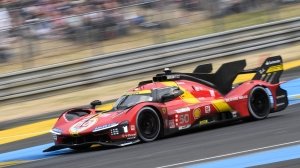
The Ferrari 499P developed for the new Le Mans Hypercar (LMH) class to compete in the FIA’s World Endurance Championship series.
Jean-Francois Monier/AFP via Getty Images
“For sure we have a bit of pressure on us, but I think we’re managing it really well,” says Fuoco to the small cadre of journalists pressed around him. “We know that tomorrow is a special day, and when you arrive on the grid and are ready to start the race, the pressure is different . . . we will try to keep this level of concentration for all of the race.”
Yet while the team is focused on the task at hand, the Prancing Horse knows that it has a lot, well, rolling on its new 499P entry in the new Hypercar class; it’s got a legacy to advance for the next generation of faithful. After all, few could have guessed that when Ferrari’s Jacky Ickx and Brian Redman permanently relinquished the lead due to mechanical issues during the 1973 contest—forcing Ferrari to settle for the second spot on the podium—it would take until this year to give it another go.
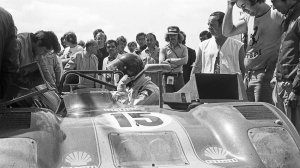
Jacky Ickx (in helmet) beside his Ferrari 312PB at the 24 Hours of Le Mans in 1973, the last year the marque competed in the race’s top category until this past weekend.
Bernard Cahier/Getty Images
It wasn’t that Maranello was abandoning the upper echelons of motorsport, far from it. The marque’s raison d’être reflects that of its founder, Enzo Ferrari, who once stated, “I have, in fact, no interest outside of racing cars.” The reason given for its departure as a factory team from Circuit de la Sarth was a shift in priority to Formula 1, which, in hindsight, was the right call considering that it has since garnered 14 Formula 1 World Constructors’ Championships and nine World Drivers’ Championships in the interim. But why consider joining the highest level of competition at Le Mans now?
“The decision to compete once more in this category stems from the change to the regulations,” says Antonello Coletta, head of the Ferrari Attività Sportive GT division, which includes the 499P’s development and implementation. “This discussion with the FIA, ACO, and IMSA began a few years ago when Ferrari started attending all the meetings where these regulations were being rewritten. When we realized that the new rules might be appealing, Ferrari decided to take part in the Hypercar class.”
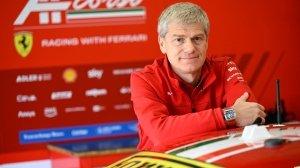
Antonello Coletta, head of the Ferrari Attività Sportive GT division, which includes the 499P hypercar’s development and implementation.
Ferrari S.p.A.
That segment is new for this season, replacing the previous Le Mans Prototype 1 (LMP1) class. The nascent Hypercar class comprises the Le Mans Hypercar (LMH) and Le Mans Daytona hybrid (LMDh), both sharing similar regulations established by the FIA, the Automobile Club de l’Ouest (ACO), and the International Motor Sports Association (IMSA). The LMDh option necessitates that the chassis is provided by one of four manufacturers—Oreca, Dallara, Multimatic, or Ligier—and has to be fit with a rear-axle hybrid system made standard by components from Williams Advanced Engineering and Bosch. It’s the choice made by Porsche for its 963 car. The LMH classification, though, does not require hybridization and allows for more flexibility and even complete control by the team, which appealed to Ferrari, an automaker renowned for holding tight to the reins.
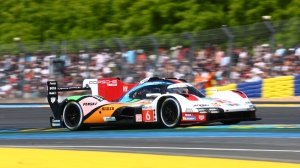
Porsche’s 963, seen here racing for Porsche Penske Motorsport this year at Le Mans, is an example of the LMDh option in the Hypercar class.
Clive Rose/Getty Images
“The only way to create the car 100 percent, which was the prerequisite for us to enter that category, was to build the whole car in its entirety,” Coletta had mentioned earlier in the year. “This was only possible in the LMH configuration. Ferrari has designed, engineered, and manufactured the body, engine, electric motor, and all the car’s components. So, as always, the car coming out of Maranello is 100 percent Ferrari.”
That doesn’t mean that there aren’t the same general parameters to adhere to. Both LMH and LMDh cars have to weigh at least 2,271 pounds and be limited to 670 hp. And the aforementioned overseeing organizations involved have tried to ensure an even playing field with the two variants by implementing Balance of Power (BoP) stipulations, which also enable each option to enter the IMSA WeatherTech SportsCar Championship, where the Rolex 24 at Daytona dominates recognition.
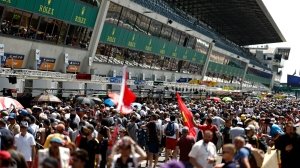
A reported 300,000 spectators were on hand for the 100th anniversary of Le Mans, a minority of which were granted access to preview pit lane before Saturday’s start.
Chris Graythen/Getty Images
As for the 499P specifically, it combines a similar engine configuration to the Ferrari 296 GT3, a twin-turbo V-6, but with reduced weight and tuning tailored to the hypercar’s performance demands. In addition, there’s a differential-fit electric motor at the front axle fueled by an 800-volt battery pack that replenishes through regenerative braking. And managing the total output is a seven-speed sequential transmission.
The story of the 499P is one Ferrari is eager to tell, a fact evidenced by Robb Report’s invitation to join a convoy of the latest models, including the Portofino, the new Purosangue SUV, and the 296 GTS and GTB, the latter of which was named our Best Sports Car for 2022. The import of the moment for Ferrari was palpable when driving past Enzo’s original office complex and out its gates. The tone was actually set by dinner the night before at Fiorano’s Ristorante Montana near the automaker’s test track. There, we supped next to a wall-sized image of racing great Michael Schumacher eating in its kitchen. The establishment itself is a museum dedicated to the Prancing Horse and frequented by the team.
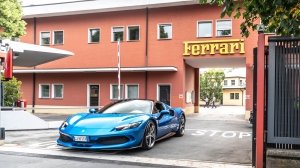
A Ferrari 296 GTB exits the gate of Ferrari’s headquarters in Maranello heading to Le Mans. Approximately 30 examples from the current model line participated in similar road trips in symbolic solidarity.
Ferrari S.p.A.
The roughly 750-mile road trip was spread over two days, the second starting with a visit to Michelin’s testing grounds and vast research and development facility in Ladoux, France. It was there that the specialized tires for the 499P were developed. Next, it was full throttle to Le Mans, with about 30 Ferraris dressed in either Blue Corsa or Rosso Imola commanding attention along the way—high-performance heralds with exhaust notes trumpeting that the marque was on a mission.
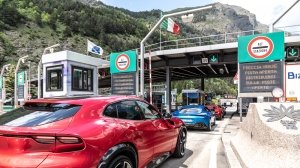
Prancing Horses crossing the border between Italy and France.
Ferrari S.p.A.
That mission began in earnest only last July, with the development of the 499P, which debuted at the 1000 Hours of Sebring on March 17, and finished third to start the seven-race season. But Le Mans is the benchmark, the loudest platform in motorsport when it comes to making a statement. That long-awaited opportunity began at 4 p.m. CEST on Saturday, June 10, as the 62-car field (also comprising Le Mans Prototype 2 cars and street-legal vehicles piloted by amateurs under the Le Mans Grand Touring Endurance Amateur (LMGTE AM class) set off on their formation lap and fired past LeBron James as he flagged them through the rolling start.
Despite securing pole position, Ferrari soon lost its two positions in front to both of Toyota’s entries, while both teams avoided ending their run early due to the elements. Rain had been in the forecast, but the cloud-laden sky unloaded rather selectively along the 8.46-mile circuit, targeting mostly the back section’s famed Mulsanne Straight, where a number of cars pirouetted right out of contention due to the water on the track, whereas the climb and descent at the Dunlop Bridge remained dry.
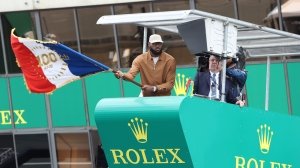
LeBron James officially commences the 24 Hours of Le Mans for 2023.
Marc Piasecki/Getty Images
After four hours of racing, the weather stabilized a bit more and, according to the official FIA updates, Peugeot was surprisingly in the lead with Porsche and Toyota in the next spots, respectively, while Ferrari had dropped out of the top five. By the eight-hour mark, the FIA notes that the rain had returned and, although Peugeot still had the lead, Ferrari had leapfrogged back over Porsche and Toyota, with Cadillac’s LMDh entry in third.
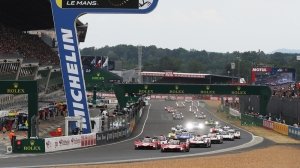
Moments after the rolling start of the race, with Ferrari in the two lead positions determined after qualifying.
Ker Robertson/Getty Images
By the halfway point of the race, the Prancing Horse’s car No. 51 had kicked to the front once again, but No. 50 had to come in for repairs. “We lost a bit of time on the pit for the issue we had, but we know the race is still long . . . we’ll see what we achieve at the end,” said Fuoco, the latter car’s driver, after following his most recent turn behind the wheel. As for Cadillac, it now had both entries in the top five.
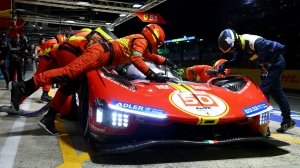
Ferrari’s car No. 50, with drivers Antonio Fuoco, Miguel Molina, and Nicklas Nielsen rotating behind the wheel, makes a pit stop.
Clive Rose/Getty Images
The only real change by 8 a.m. Sunday morning, at least as far as the handful of hypercars, was Porsche Penske Motorsport surrendering another position to Cadillac, who were the only team with two cars in the breakaway field of five. But the men of Maranello were not giving quarter, despite Toyota ready to usurp control at any moment.
Of his part in fending off the threat, Ferrari pilot James Calado commented, “It was a pretty tough stint because we triple-stinted one set of tires, we didn’t change but just went for it, it’s touch and go . . . Toyota is very, very strong, but we’re able to hang on at least.”
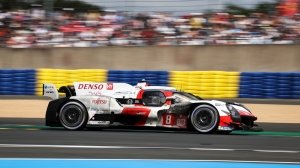
Toyota Gazoo Racing’s car No. 8 on the hunt for a sixth consecutive win for its team.
James Moy Photography/Getty Images
The final few hours of the contest really came down to the two storied marques, as Toyota was gunning for its sixth overall win. But motorsport is about the moment, and a piviotal one for both teams happened in the final 104 minutes. That’s when Ryō Hirakawa, in Toyota’s car No. 8, suddenly lost control of the back end, spun, and had to basically navigate a multiple-point turn while contending with traffic before resuming the chase.
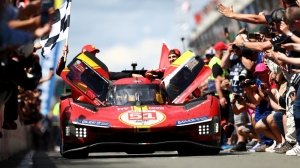
A lifetime of bragging rights for Ferrari’s close-knit team and a new automotive icon in the Ferrari 499P No. 51.
Clive Rose/Getty Images
Hirakawa’s setback triggered an eruption of cheers from the Ferraristi gathered at Casa Ferrari, a two-story sanctuary for invited guests and elite customers. An undercurrent of nervous anticipation quickly followed, however, as nobody dared consider victory a done deal. It wasn’t until No. 51 passed in front of them for the last time as he navigated the Ford Chicanes on his final approach to the finish line, and apprehension gave way to elation amplified by a wave of logoed banners, flags, and song.
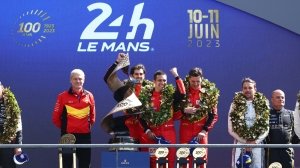
From left, Ferrari’s 499P head Antonello Coletta and drivers Antonio Giovinazzi, Alessandro Pier Guidi, and James Calado bask in the podium’s glow of victory.
Clive Rose/Getty Images
Yet even the revelry that ensued seemed to understate the gravitas of the achievement that instantly became one of racing’s iconic moments, one that all present had been a part of. When asked to put this win in perspective as far as Ferrari’s legacy, team head Coletta, paused for a beat, then told Robb Report, “After 50 years, I feel this victory will be one of the most important ever.”
[bsa_pro_ad_space id=15]