
[bsa_pro_ad_space id=14]


Do you want a Ford Ranger but can’t abide the long waiting times? We have the answer, and you might just be getting a better value ute in the bargain.
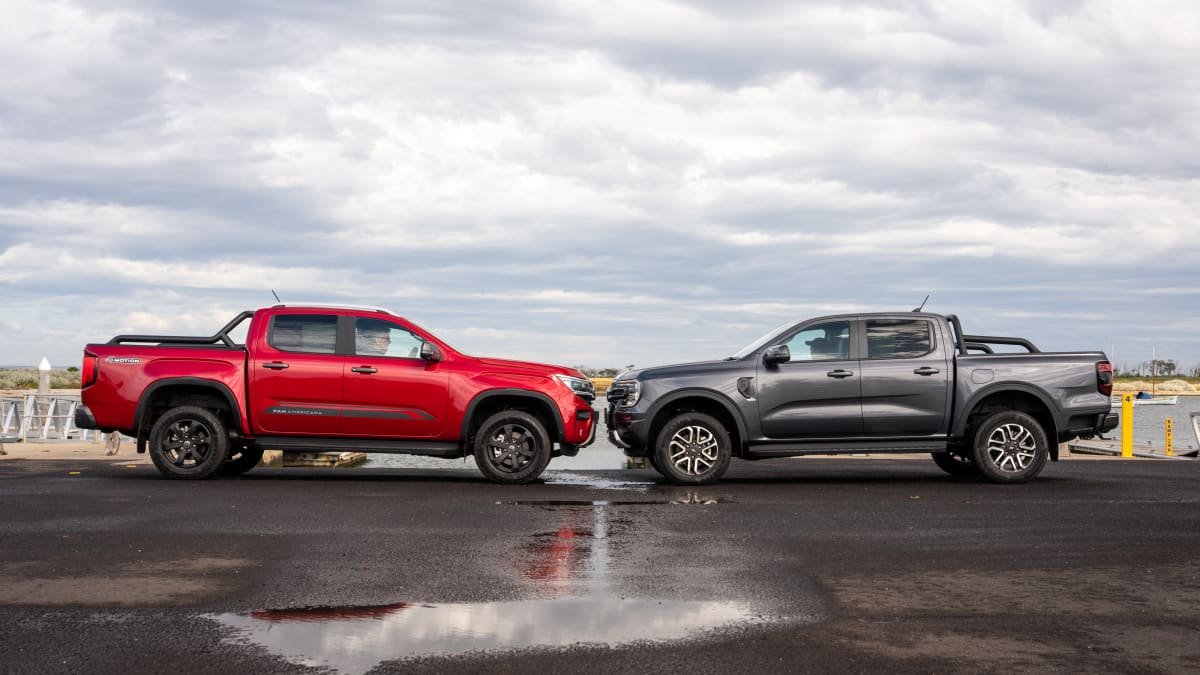
It’s a battle as old as the Bible. Cain and Abel all over again, except in utes.
Superficial types will dismiss this as a non-comparo, because the Ford Ranger and Volkswagen Amarok are twins under the skin. They were both developed by Ford under a collaborative arrangement.
This kind of inter-brand product collaboration has been going on since the early 1980s, with mixed success. Car brands do it because it’s cheaper to share development costs with a partner.
That means nothing to the consumer, and nor should it. Why do we care if car Brand A saved money partnering with Brand B to develop a new ute? All that matters is that the consumer gets a vehicle that is up-to-date and competitive, and it exhibits characteristics in line with the badge on its bonnet.
That last point is where the Mercedes X-Class fell down. It was a Benz that looked, felt, and drove like a Nissan.
Have Volkswagen and Ford been more successful in differentiating their two utes, and is each true to the badge on its bonnet?
That’s what we’re here to find out.
We don’t mind waiting, and we can pick when you return.
| Key details | 2023 Ford Ranger Sport V6 | 2023 Volkswagen Amarok Style V6 |
| Price (MSRP) | $67,690 plus on-road costs | $70,990 plus on-road costs |
| Colour of test car | Meteor Grey | Deep Red Metallic |
| Options | Metallic paint – $700 | Metallic paint – $990 Savona leather – $3000 |
| Price as tested | $68,390 plus on-road costs | $74,980 plus on-road costs |
| Drive-away price | $74,985 (Vic) | $81,031 (Vic) |
The second-generation Volkswagen Amarok is based on the latest Ford Ranger – and is made in a Ford factory in South Africa rather than Thailand where Australian-stock Rangers are built – but it has received a significant visual overhaul.
During development of the new Amarok, Volkswagen Germany assigned a dedicated team of engineers to work alongside the Ford Ranger team in Australia, with one significant difference: Ford’s designers and Volkswagen’s designers worked in isolation. That way, each ute’s styling would be faithful to its parent brand.
Get a great deal today
Interested in one of these cars? Complete your details and we’ll connect you to our team.

Volkswagen has gone to great lengths to differentiate its new Amarok inside and out, including unique sheetmetal for every panel other than the roof, and a completely revamped interior that adopts a Volkswagen steering wheel, digital displays, and unique switchgear, among other changes.
Ford, as you probably know, offers the Ranger as a pick-up and cab chassis in both 4×2 and 4×4 configurations with single cab, super cab and dual-cab bodies. We’re going to focus specifically on four-wheel-drive dual-cab pick-ups for this comparison because that’s all Volkswagen offers in the Amarok range.
We’re also going to ignore the Ranger Raptor because Volkswagen has no equivalent to this higher-performance utility.
This comparison was originally planned for a mid-range Amarok Style and a Ford Ranger Sport. Then, at the 11th hour, Volkswagen swapped our Style for a higher-specced PanAmericana, saying only that the Style test vehicle was needed elsewhere.
That switcheroo left us with a potentially lopsided comparison, but we’ll do our best to keep this on an even keel as we sail on. To that point, all the specs panels in this report compare the VW Amarok Style V6 to the Ford Ranger Sport V6.
Both our test vehicles have the more powerful 3.0-litre V6 turbo diesel mated to Ford’s 10-speed automatic transmission. The Ford Ranger Sport V6 is priced at $67,690 plus on-road costs. The VW Amarok PanAmericana is $75,990 plus ORCs.
If we’d been given the VW Amarok Sport V6 as originally agreed, that vehicle’s price is $70,990 plus ORCs.
That’s a bit of a price difference. But look past the VW’s black alloys, black bumpers, black mirrors and black everything else and you’re essentially looking at a Volkswagen Amarok Style.
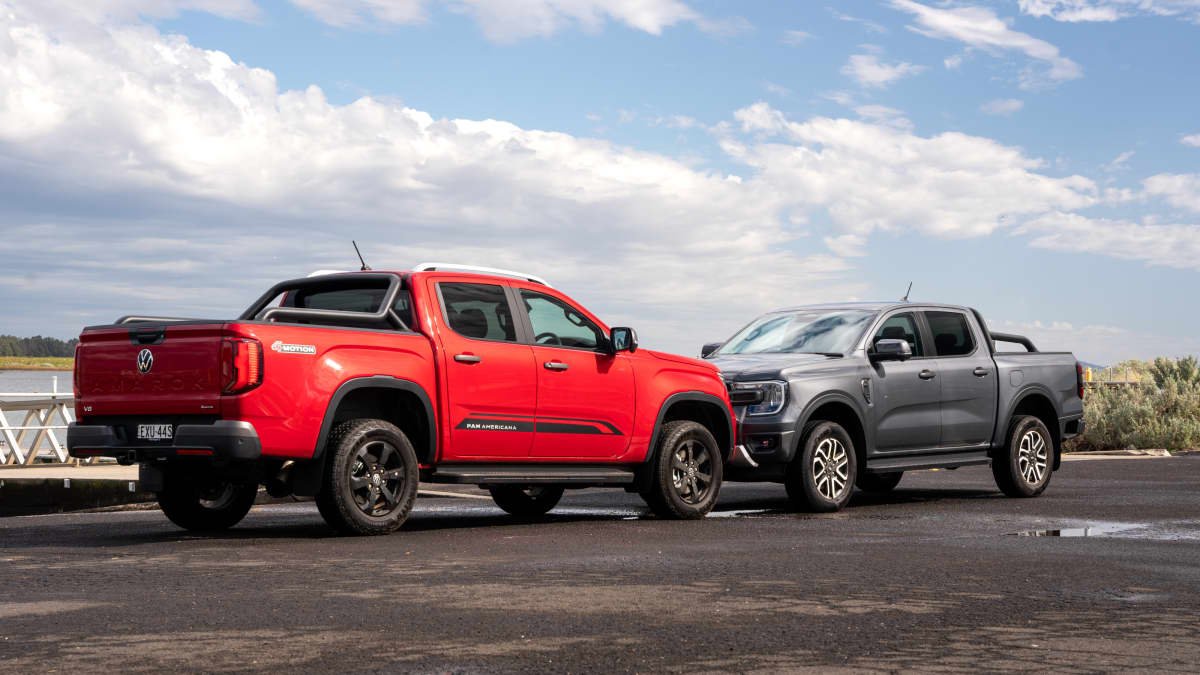
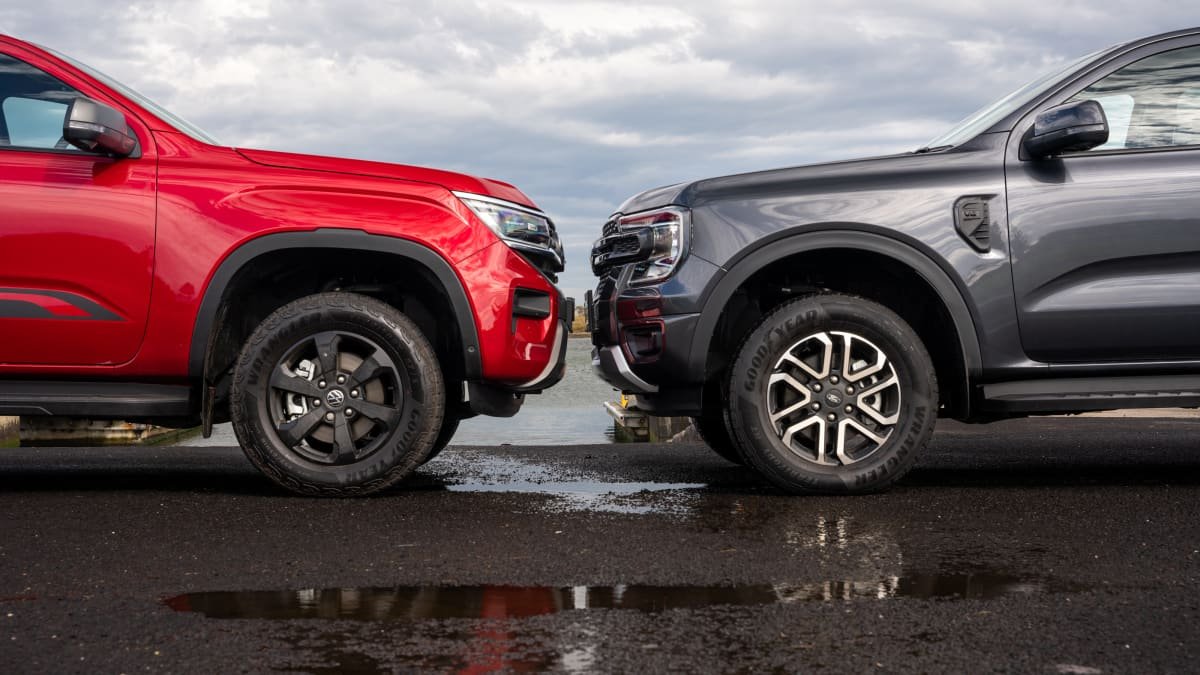
Side by side, the sheetmetal design differences are obvious. Every panel except the roof is different. Even the doors are skinned differently, although the door apertures are identical.
Dimensionally, there’s a wafer between the two. The Ranger is 20mm longer bumper to bumper and a paltry 8mm wider. We’d be prepared to dismiss those discrepancies because it could come down to measuring protocols and it makes not a skerrick of difference to versatility and space. Plus both are the same height.
Interestingly, Ford’s brochure quotes front and rear track at 1620mm each, whereas VW claims a 1620mm front track and 1650mm rear track. The difference – if there really is one – could be suspension geometry (VW claims it has tweaked the suspension) or wheel offset because both test vehicles ride on the same size tyres.
For the record, our Ranger Sport is shod with Goodyear Wrangler highway-terrain 255/65 R18 tyres and the PanAmericana wears Goodyear Wrangler all-terrain 255/65 R18s.
| 2023 Ford Ranger Sport V6 | 2023 Volkswagen Amarok Style V6 | |
| Seats | Five | Five |
| Length | 5370mm (5406mm w/ tow receiver) | 5350mm |
| Width excluding mirrors | 1918mm | 1910mm |
| Width with mirrors | 2208mm | n/a |
| Height | 1886mm | 1886mm |
| Track (front/rear) | 1620mm / 1620mm | 1620mm / 1650mm |
| Wheelbase | 3270mm | 3270mm |
| Tub L x W x H | 1464 x 1217 x 525mm | 1544 x 1224 x 529mm |
| Payload | 958kg* | 1031kg |
| Tare weight | 2258kg* | 2319kg |
| Gross Vehicle Mass (GVM) | 3280kg | 3350kg |
| Tow rating (braked) | 3500kg | 3500kg |
* See ‘Weights’ section below for an explanation of why the Ford’s weights make no sense.
Both our test vehicles are fitted with the same 3.0-litre turbo diesel V6 engine with 184kW and 600Nm, driving all four wheels through a 10-speed automatic transmission.
Kerb weights are, well… they’re a mess because somebody at either VW or Ford thinks Tare equals Kerb, which it doesn’t.
Volkswagen’s brochure claims a tare mass for the Amarok Style of 2319kg. It makes no kerb weight claim and says the Style can carry a payload of 1031kg. Gross Vehicle Mass, says VW, is 3350kg. The PanAmericana’s figures are identical.
Ford’s brochure says the Ranger Sport V6 has a tare weight of 2258kg, a kerb weight of 2250kg (min) and 2322kg (max), and can carry a 958kg payload. Ford quotes a GVM of 3280kg.
Both are rated to tow up to 3500kg and have a quoted Gross Combined Mass of 6400kg.
On the surface, those payload figures appear to favour the Amarok, but we don’t see how that can be different, so let’s call it a clerical error.
For the record, Ford measures its minimum kerb weight with “a full tank of fuel, without occupants, luggage or cargo, and with the lightest possible orderable combination of factory fit equipment”.
Tare weight, says Ford, is “10L of fuel, without occupants, luggage or cargo, and with the heaviest possible combination of factory fitted optional equipment”.
Maximum kerb weight is full fuel but no occupants, luggage or cargo, and the heaviest factory-fit equipment.
Getting this right is important because many owners will customise their dual cabs, and they need to know how much weight they have to play with before exceeding the GVM with adults and luggage onboard.
We recommend a weighbridge.
| At a glance | 2023 Ford Ranger Sport V6 | 2023 Volkswagen Amarok Style V6 |
| ANCAP rating & year tested | Five stars (tested 2022) | Five stars (tested 2022) |
| Safety report | ANCAP report | ANCAP report |
ANCAP has recognised both utes as five-star vehicles, so there’s no tangible difference in passive safety.
Active safety is another matter, but we should say from the start that both of these vehicles are among the best in the class.
By virtue of the new (Ranger) platform, this generation Volkswagen Amarok gains autonomous emergency braking, intelligent speed limiter, traffic sign recognition, adaptive cruise control (with lane centring), lane-keep assistance, lane-departure warning and blind-spot monitoring.
The airbag count has gone up as well, with curtain airbags (for both rows of seating), front centre airbag and a driver’s knee airbag.
No surprises for guessing that both have the same active safety features. All the big names are there, and it makes no difference in Amarok-land if you choose the Style or the PanAmericana. You’re getting an active safety burger with the lot.
The same can’t quite be said for the Ranger Sport because it misses out on Active Park Assist, which is only fitted to Wildtrak and above.
The Amarok’s LED Matrix headlights are another advantage. They’re standard on Style and above, but in Ford-land only the Ranger Platinum and Raptor get Matrix LEDs standard. They’re optional on Wildtrak and not available on Sport.
The Amarok Style is the cheapest Amarok with advanced adaptive cruise control (with stop/go and road-sign speed recognition). Ford fits this tech to the XLT spec and above.
Both come with a tow bar, but only Ford gives you the integrated trailer brake controller for free. Volkswagen charges a little extra.
The similarities are immediately obvious, but sit in the cabin for even a few seconds and the differences emerge.
The biggest difference by far absolutely has to be the Volkswagen’s missing Macca’s fries holder ahead of the gear selector. What, don’t VW owners like a cheeky McBurger and fries every now and then?
Jokes aside, there are visual differences and practical differences, and then there are differences just for the sake of being different.
The Ford Ranger Sport has leather-look seats and trim as standard, but the Amarok Style comes with velour seats and faux leather trim instead. A full leather interior is a $3000 option on the Style.
Volkswagen’s front seats are installed by Ford but are assembled to a different specification with firmer foam, making them a touch more comfortable during longer stays. Both vehicles’ driver’s seats are power adjustable and the passenger front seats are manually adjustable.
It’s pleasing to see that front and rear floor mats are included in the purchase price with Volkswagen and not a sneaky extra cost option.
As for the rest of the interior, the most obvious carry-over into the VW from the Ford is the Golf club gear selector.
The steering wheel is Volkswagen’s own, which makes a lot of sense as it’s the most used touchpoint.
The Volkswagen gets a second glovebox above the first but loses the outboard cupholder slot on the passenger side. On the driver’s side this is filled by the headlight knob.
The air vent covers are unique too. The Ford’s covers mimic a chunky off-road tyre, whereas the VW’s are more understated.
The Amarok’s wireless phone charger has been turned 90 degrees to make room for the trailer gain adjuster alongside, instead of in the lower dash behind the steering wheel.
So, does one interior work better than the other? No. Does the VW’s interior look and feel more upmarket than the Ford’s? Yes, but mainly because of the screens’ graphics, which we will get to next.
As for spec differences, the Amarok Style V6 is marginally better equipped than the Ford Ranger Sport V6 – adding features such as a larger touchscreen (12.0-inch v 10.0-inch), 10-way power driver’s seat (eight for the Ford), and a widescreen digital instrument cluster (12.3-inch v 8-inch).
Both infotainment screens mirror smartphones via wired or wireless connectivity and charge them wirelessly.
Volkswagen has opted to use Ford’s hardware (rather than grafting in its own), but importantly has reskinned the 12.0-inch central screen and 12.3-inch driver instrument cluster with its own graphics.
Everything underneath works exactly the same way, right down to the glitches that continue to marr our enjoyment of the Ranger’s infotainment system.
Volkswagen’s decision to reskin the two digital displays is the right one: it’s fundamental to giving each car its own character.
Ford’s own set-up is a good design, but so is the Amarok’s.
The software needs refining, however, to remove hiccups and glitches. In general the system works well, but we experienced at least half a dozen instances where the system struggled. Sometimes, it would take seconds to respond to a menu selection, build new screens line by line like an old-fashioned dot-matrix printer, or just freeze altogether.
We’ve seen this in multiple Rangers, and now we know the Amarok is not immune to these software issues either.
Volkswagen claims to have fettled suspension settings, but it makes no such claim about the powertrain. So it’s no surprise that there’s really no difference between the two in powertrain performance. So any Ranger versus Amarok drag races will totally come down to driver reaction time.
We felt no difference in ride quality or vehicle dynamics on real-world roads either. If there’s a difference, it will take a lot more than 150km of back-to-back testing over the exact same road loop to manifest, or harder driving closer to the vehicles’ dynamic limits than is safe on public roads.
The only dynamic difference we could identify came down to steering effort. The Volkswagen’s steering assist is stronger so the steering is lighter, which makes it a touch easier to manoeuvre at low speeds.
| Key details | 2023 Ford Ranger Sport V6 | 2023 Volkswagen Amarok Style V6 |
| Engine | 3.0-litre V6 turbo diesel | 3.0-litre V6 turbo diesel |
| Power | 184kW @ 3250rpm | 184kW @ 3250rpm |
| Torque | 600Nm @ 1750–2250rpm | 600Nm @ 1750–2250rpm |
| Transmission | 10-speed automatic, Low-range 4×4 w/auto mode |
10-speed automatic, Low-range 4×4 w/auto mode |
| Power-to-weight ratio | 79.2kW/t | 79.4kW/t |
| Weight | 2322kg | 2319kg |
| Spare tyre type | Full-size | Full-size |
| Turning circle | 12.9m | 12.8m |
Jump into the tub and it’s another game of millimetres. Forget payload ratings; we’re still thoroughly confused from our weights investigation earlier on. Let’s look at measurements.
Opening and closing both tailgates is ridiculously easy because both feel very light thanks to counterweights or cantilevers or fairy dust or whatever Ford engineered into the mechanism. It’s bloody good. Both are lockable from the key fob, which is also great.
Only the Ford has a sidestep to make getting into the tub easy. Volkswagen expects you to stand on the rear bumper or the tyres, with no easy access with the tailgate open.
Previous Rangers we’ve tested came with a ruler moulded into the tailgate, apparently for measuring twice before you cut. The Ford’s tailgate also has recesses for clamping the wood while cutting. This particular Ranger Sport had a drop-in tub-liner, the seal for which covers the ruler, though it still exists underneath.
The Ford’s tray also has a domestic power socket and a 12V socket.
The Volkswagen keeps the ruler, but like the Ford it’s covered on the Style with a drop-in liner, but doesn’t have clamp recesses because Amarok owners don’t cut wood on their $70K ute. We’re guessing they use a $25 Bunnings sawhorse instead.
Also, the PanAmericana doesn’t have a 12V socket in the tray, but the Style does. If the PanAmericana is aimed at explorers and campers, wouldn’t they like a power source in their tub?
As for the trays themselves. Both have tough tray bedliners, uniquely designed. The Amarok’s yields 7mm more width between the arches, 4mm more length and 4mm more height.
Neither vehicle’s purchase price includes a soft tonneau cover or hard tray lid.
Unlike the copy-paste job that Mazda did with Isuzu’s platform, Volkswagen has clearly spent time and effort differentiating the Amarok from the Ranger.
Exterior styling differences are a personal choice, so we’ll not use that as a deciding factor. For the record, our test crew were divided. I like the Amarok’s more refined exterior styling that draws inspiration from the Touareg large SUV. Others preferred the Ranger’s bolder exterior graphics.
Interior design, layout and functionality is a win to … the buyer. It will really come down to which steering wheel you like and which smartphone charge mat orientation. Or maybe the McDonald’s fries holder.
There’s really nothing to split the two on towing capability or load carrying, even though we did not test it here. We didn’t need to.
Safety is a narrow win to the Amarok, purely because the Style is better equipped than the Ranger Sport. Same goes for interior equipment, but don’t forget that the Style costs more.
Before you ask, yes, bigger infotainment screens, more advanced headlights and more active safety/semi-autonomous assistance does bridge much of the $3300 MSRP gap.
But then Volkswagen goes and fits velour trim where the Ranger offers leather-look trim. That tips the scales back the other way on the spreadsheet. What it also does is inject just enough spec difference to force the user to choose.
We’re talking about practical buyers who weigh competing vehicles on their merits and decide which better suits their lifestyle. We’re not talking about brand devotees who just want a Blue Oval, or the ute with the most street cred.
Which one would I choose? The answer probably says more about me than it does these two utes. I prefer the visually more refined and better-equipped Amarok Style, although the lack of leather makes me hesitate.
It’s a fair bet many others will prefer the Ranger with its bolder graphics inside and out, and its other unique charms.
Ownership costs may make the decision easier for pragmatic, spreadsheet-driven buyers.
Both drivetrains are identical so fuel consumption won’t differ. As for servicing costs, the Ford Ranger’s five-year total is $1716 to the Amarok’s $1800.
Comprehensive insurance quotes also fall in favour of the Ford: $1796 to $1916. We’ve no idea why this discrepancy exists for two mechanically identical vehicles. Do VW Amarok drivers crash more? Does VW charge more for labour?
Still, the differences add up to a not-inconsequential $684 over five years. That’s a decent anniversary dinner for you and your partner.
So, if we add in the additional upfront cost, the question becomes: is the Amarok worth $3984 more over five years?
| At a glance | 2023 Ford Ranger Sport V6 | 2023 Volkswagen Amarok Style V6 |
| Warranty | Five years, unlimited km | Five years, unlimited km |
| Service intervals | 12 months or 15,000km | 12 months or 15,000km |
| Servicing costs | $987 (3 years) $1716 (5 years) |
$1072 (3 years) $1800 (5 years) |
| Fuel cons. (claimed) | 8.4L/100km | 8.4L/100km |
| Fuel cons. (on test) | 9.1L/100km | 9.2L/100km |
| Fuel type | Diesel | Diesel |
| Fuel tank size | 80L | 80L |
SO, WHY BUY THE VOLKSWAGEN AMAROK?
Two words: exclusivity and availability.
Buy a Ford Ranger and you become just another one of the 60,000 more Australians driving a Ford Ranger every year.
But, buy a Volkswagen Amarok, which is essentially a Ford Ranger in a different outfit, and you’ll not only stand out in the ute crowd, you’ll likely get your vehicle months sooner than Ford can deliver.
Really, though, whichever way you fall, you’re getting the best ute in Australia, and Drive’s reigning Car of the Year.
Read more about Glenn Butler
[bsa_pro_ad_space id=15]