
[bsa_pro_ad_space id=14]


Have we entered a new EV arms race? Rather than chase optimal speed or technology, the Hyundai Ioniq 6 ‘electrified streamliner’ is chasing optimal efficiency. Is this the right path?

What we love
- It’s the most efficient EV on the market, even in real-world conditions
- Enjoyable handling, to the point where it feels like a ‘regular’ car
- In the right spec, it looks decidedly interesting and, dare I say, cool

What we don’t
- In the wrong spec, that efficient profile just looks a bit awkward
- Tight boot opening and compromised rear passenger comfort offer limited appeal
- Beep. Beep. Boop. Beep – maybe back off the driver warnings a smidge
Back in the 1930s, transportation design took a step toward a more efficient future as we entered the ‘streamliner’ era of railway travel. This period saw once simply functional steam and diesel locomotives trade their flat-fronted tanks, exposed wheels and open tenders for raked noses, wheel spats and even paired rolling stock.
Sure, style played a part, this was Art Deco at its peak, but the true benefits were in the efficiencies felt on the rails. Streamliners slipped through the air faster and used less fuel than their conventional counterparts on long distance runs.
Aerodynamic-centric designs have never looked back, and in the automotive world we have long seen brands bragging about drag coefficient ratios (Cd) that strive for an ever lower number for even more optimal efficiency.
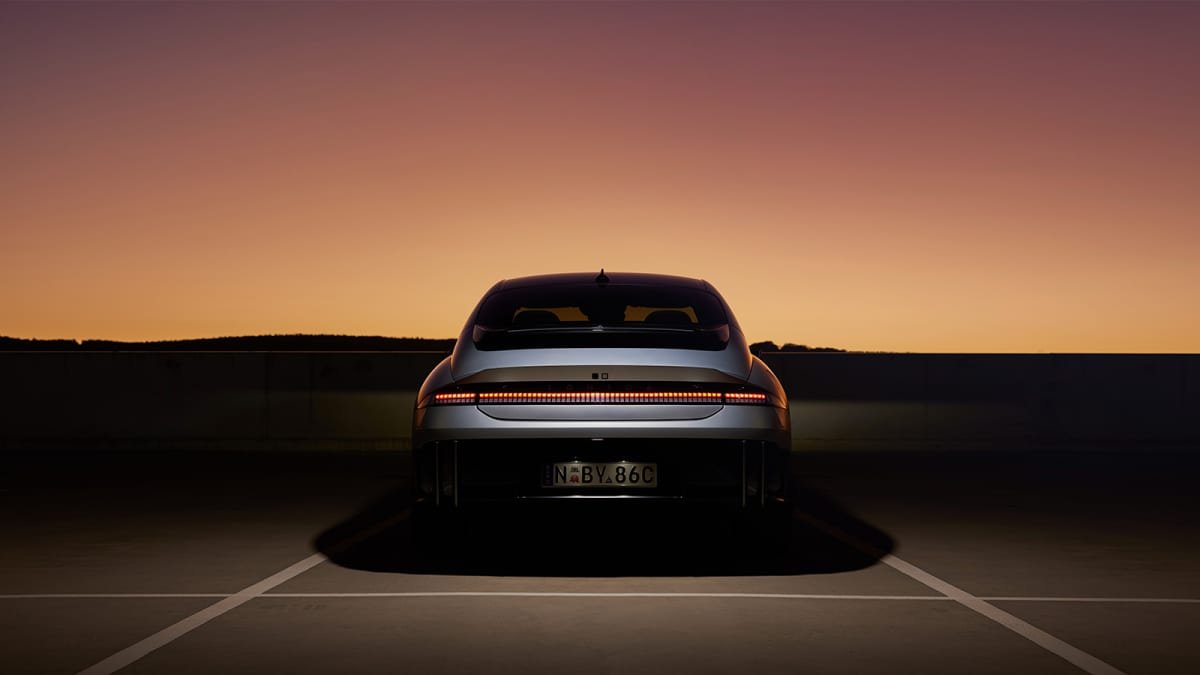
These are the elements at the core of the all-electric Hyundai Ioniq 6 (a car the brand refers to as an ‘electrified streamliner’), the latest machine to use the E-GMP EV platform that we’ve already seen underpin the Hyundai Ioniq 5, Genesis GV60 and Kia EV6. Except this time, rather than an SUV or hatch-shaped body, the Ioniq 6 is a swoopy, aerodynamic sedan, that rides low, looks sporty and claims an impressive Cd of just 0.217.
For context, that puts the Ioniq 6 right up with the Mercedes-Benz EQS (Cd: 0.20), Tesla Model S (Cd: 0.208) and Lucid Air (Cd: 0.21) as one of the most aerodynamic cars available today.
What that means for Australian car buyers, is we may very well have a new efficiency leader on the market. This is a good thing, as after all, isn’t that what our new-energy journey is all about?
How much does the Hyundai Ioniq 6 cost in Australia?
The Hyundai Ioniq 6 is offered in three variants and with either a single-motor or dual-motor driveline.
All models use the same chassis architecture with a 77.4kWh battery pack, 350kW capable charging system and a Vehicle-to-Load (V2L) function integrated within the platform. This means core technologies like Hyundai SmartSense safety and assistance tech, over-the-air (OTA) connectivity and even intelligent matrix-LED headlamps are included across the range.
Pricing starts from $74,000 before options and on-road costs for the rear-drive, 168kW/350Nm single-motor Dynamiq model, but then jumps up to $83,500 for the all-wheel drive 239kW/605Nm twin-motor Techniq variant. Here you are treated to larger 20-inch alloy wheels, a sunroof, a heated rear bench and steering wheel, plus the ‘lounge’ recline front seats.
There’s a further step to the range-topping $88,000 Ioniq 6 Epiq, as featured in our video, which adds a heat pump, battery preconditioning system and digital wing mirrors.
Personally, I would like to see the single-motor driveline offered in the Techniq grade as this looks much better (the 18-inch aero-design alloy wheels on the Dynamiq are very ordinary), and this is the most efficient way to power your Ioniq 6… but more on that shortly.
Get a great deal today
Interested in this car? Provide your details and we’ll connect you to a member of the Drive team.
These price points place the Ioniq 6 entry point significantly higher than the $64,300 (before on-road costs) Tesla Model 3 rear-wheel-drive and $63,900 (before on-roads) Polestar 2 in both standard and long-range ($68,400) guise. It’s also more expensive than the $72,590 Kia EV6 Air and $72,000 Hyundai Ioniq 5 Dynamiq, which must be awkward at family dinner time.
It is well equipped though, with the Polestar for example requiring both the Pilot Lite Pack ($3400) and Plus Pack ($6000) to match the standard technology spec of the Hyundai.
Your specification of the Ioniq 6 is important too, as some of the eight colour choices (black, white, dark green, red, grey, blue, dark purple and silvery-gold) work better than others (looking at you Byte Blue). The pick of the paint palette is Gravity Gold matte, which at $1000 is the only option choice you need to pay for (all other gloss colours are no-cost).
| Key details | 2023 Hyundai Ioniq 6 Epiq |
| Price | $88,000 Plus on-roads |
| Colour of test car | Gravity Gold matte |
| Options | Matte Paint – $1,000 |
| Price as tested | $88,000 Plus on-roads |
| Drive-away price | $88,000 Plus on-roads |
| Rivals | Tesla Model 3 | Polestar 2 |
How much space does the Hyundai Ioniq 6 have inside?
As with most ground-up electric cars the interior of the Ioniq 6 has bee designed to be usable and spacious without having to deal with the compromises of transmission tunnels and exhaust channels.
What it does have to deal with are the compromises presented from a battery below the floor and a roofline that was designed around a wind tunnel rather than occupants taller than six-foot. More on that in a moment though, as the predominant approach to the cabin is very positive.
Take the door cards for example, that have been ‘slimmed’ due to the relocation of the window controls to the middle of the console. This adds a few centimeters here and there, which may sound insignificant, but its part of the considered approach to the layout of the Ioniq 6 that really matters. The door pads are still useful to rest an elbow on, and they still house the multi-coloured ambient lighting system, but your knees (especially as a passenger) have a little more room to breathe.
There’s twin-deck storage in the center console which allows for cups and a wireless phone charger up top and a tray for bags below. There’s a decent-sized cubby under the arm rest as well as a large slide out glovebox for the passenger. Hyundai note that the top of the console has been designed to be flat so that you can rest your laptop on it should you need to bash out some work (or a review) while the car is parked up and charging.
The dashboard layout is clean, with a single vent-strip separating the climate control functions and twin 12.3-inch infotainment displays. The Epiq houses the OLED monitors for the digital mirrors in sort of a folded collar or wing at either end of the dash, but cars without these maintain the element which just adds a bit of an interesting texture to the whole dashboard structure.
And yes, I prefer the regular mirrors to the new-fangled monitors, perhaps because I’m used to the behaviour exhibited by a reflection rather than a projection, but here we are.
There are four interior colour options available (light grey seats with either dark green or dark grey upper, brown seats with black upper and black seats with black upper), and the quality of the materials is generally high. To keep with the efficiency theme, Hyundai have also tried to keep the interior as sustainable as possible too.
For example some of the trim on the dashboard is made from sugar-cane sourced fibres. There’s a bio-plastic fabric used for the headliner and the floor mats are made from recycled fishing nets. Nice.
Step into the back seats and the car’s near 3-meter (2950mm) wheelbase affords rear passengers a huge amount of legroom, but as I noted above, the higher floor (due to the battery pack) and sloping rear window line make the back seat a little odd for taller occupants.
Slip in under 6-feet and you’ll be OK, but if you’ve got a tall body or long legs, and intend to spend a lot of time in the back of the Ioniq 6, I’d suggest a sit in one before you make the decision.
I found the bench was too close to the floor so my legs, albeit with ample room between the back and front seats, sat high and pushed my thighs off the seat base. I couldn’t stretch out as the front seats are too low and close to the floor so there is no toe room under them.
This in turn makes setting a driving position a little fiddly, as unless the seat was as low as it can go, my right knee kept bashing the transmission stalk to the right of the steering wheel.
These aren’t huge concerns though, as a bit of repositioning and I was able to make myself comfortable both as a driver and passenger, but it’s certainly something worth checking if you are tall or will be carting taller passengers about.
Also worthy of note is the smallish boot, and equally smallish aperture.
Remember the Ioniq 6 is a sedan rather than a liftback, and although you can fold the rear seats 40:60, this is not a load carrying vehicle. There is enough room for golf or overnight bags, so it is usable, but just remember that if space and practicality are your key drivers, perhaps look at the Ioniq 5 first.
| 2023 Hyundai Ioniq 6 Epiq | |
| Seats | Five |
| Cargo area (VDA) |
Front (AWD models): 45L (14.5L) Rear: 401L |
| Length | 4,855 mm |
| Width | 1,880 mm |
| Height | 1,495 mm |
| Wheelbase | 2,950 mm |
Does the Hyundai Ioniq 6 have Apple CarPlay and Android Auto?
The now familiar Hyundai/Kia infotainment system is comprised of a pair of 12.3-inch LCD screens to handle the primary menu, navigation, and telephony functions as well as the driver’s instrument cluster.
An eight-speaker BOSE sound system is standard in all models too.
Smartphone projection through Apple CarPlay and Android Auto is supported through use of a cable. The Ioniq 6 features a number of USB-C and USB-A ports around the cabin, as well as a wireless charging bay, so you should not have too much trouble finding somewhere to plug it in.
As with all other experiences with this system, the huge range of features and functions can seem daunting at first, but once you get used to how you use it, it all becomes very simple. The small split-screen function on the main display is a particular favourite to provide two points of information at the same time.
While we didn’t test the system exhaustively, but know from experience with other Hyundai products that it’s generally fast to respond to inputs and is largely reliable to use in either its native or device projection modes.
New to the Ioniq 6 is a feedback system by way of four lights on the steering wheel, very similar to what you’ll see on a Google smart speaker. These perform basic functions, like lighting up red when the car is in reverse and blue when in drive, and they’ll also switch to a multi-colour setting to show when the car is waiting for a voice command or other input.
Like many of these new features that no-one really asked for, it seems to work well but I’m not sure why we need it. I like that it creates a stronger link between the car and home-based digital devices, the jury is still out on how handy it really is.
The Ioniq 6 is also equipped with Hyundai’s Bluelink telemetry software so you can communicate with the car remotely using the Bluelink app on your phone. A data SIM card is built into the car to allow communication access, which also includes remote over-the-air (OTA) software updates. We will spend a bit more time testing the Bluelink functionality at a later date.
Worth noting too that the voice command system didn’t work too well for me, and couldn’t understand some simple navigation requests. These are the sorts of things that an OTA update can address, so I’m keen to try another Ioniq 6 again in a few month’s time.
Is the Hyundai Ioniq 6 a safe car?
Impressively, the Hyundai Ioniq 6 launches with a five-star ANCAP safety rating, and was tested in 2022.
Scores for adult occupant protection are very high (97 per cent), while the child occupant protection result was marked down (88 per cent) due to the lack of restraint systems (ISOFIX, top-tether etc) in the front passenger seat and rear center seat.
What safety technology does the Hyundai Ioniq 6 have?
Hyundai have thrown the acronym alphabet at the Ioniq 6 as it features the full gamut of their SafetySense assistance suite.
There’s a new forward-collision mitigation system that can deal with a car that crosses the center line to risk a head on collision as well as the usual raft of lane keep, blind spot and adaptive cruise control aids.
All the systems we used work well enough, especially the parts that beep at you if they don’t like something.
This became a little annoying on our drive as, for example, the speed limit warning system will alert you to a school-zone speed outside of a school-zone time and beep at you as if you’ve made a dire mistake. You can turn all this off, but it does reset each time you start the car, so we’d prefer to see one of these OTA updates add a sensitivity setting that saves as part of your driver profile.
This way you still keep the systems active, but perhaps dialed back a bit.
A head-up display is standard on all Ioniq 6 models, as is a surround-view camera and the ability to remote-park the car, even in a reverse-angle parking spot.
How much does the Hyundai Ioniq 6 cost to maintain?
There is no servicing information represented for the Ioniq 6 at this point, but we can assume it is very similar to the Ioniq 5 due to the shared architecture.
Intervals are every two-years or 30,000km with the first costing $570 and the second $1090. The third and fourth service follow this same pattern, taking the total cost over eight-years (96-months) to $3320.
Insurance is quoted at just under $3000 per year ($2946.46) based on a comparative quote for a 35-year-old male driver, living in Chatswood, NSW. Insurance estimates may vary based on your location, driving history, and personal circumstances.
| At a glance | 2023 Hyundai Ioniq 6 Epiq |
| Warranty | 8 Year, 160,000km high-voltage battery |
| Service intervals | 24 months or 30,000km |
| Servicing costs | $570 (2 years) $1660 (4 years) |
| Energy cons. (claimed) | 16.9kWh/100km |
| Energy cons. (on test) | 21.1kWh/100km |
| Battery size | 77.4 kWh |
| Driving range claim (WLTP) | 519km |
| Charge time (7kW) | approx. 11hr 45min |
| Charge time (50kW) | approx. 1h 13m |
| Charge time (350kW max rate) | approx. 18m (claimed 10-80%) |
Is the Hyundai Ioniq 6 fuel efficient?
Our first leg of driving, in the twin-motor Ioniq 6 Techniq, was one where the car’s performance and response was given a solid test. In this environment, over a country touring loop between Albury and Yackandandah on the Victoria/NSW border, we saw an average energy use of 21.1kW/100km.
This is higher than Hyundai’s claim, but the driving was outside the norm too.
We then took an Ioniq 6 Dynamiq rear-drive, with the 614km range and 14.3kW/100km efficiency claim, back to Melbourne and explored a number of driving scenarios along the 300km drive. Our results were interesting, and quite impressive, so stay tuned to find out all the details after we’ve crunched the numbers.
Sufficed to say, the Ioniq 6 is claimed to be the most efficient EV available today with good reason.
| Energy Efficiency | Energy Stats |
| Energy cons. (claimed) | 16.9kWh/100km |
| Energy cons. (on test) | 21.1kWh/100km |
| Battery size | 77.4 kWh |
| Driving range claim (WLTP) | 519km |
| Charge time (7kW) | 11h 45m |
| Charge time (50kW) | 1h 13m |
| Charge time (350kW max rate) | 18m (claimed 10-80%) |
What is the Hyundai Ioniq 6 like to drive?
There are a lot of surprising elements to the Hyundai Ioniq 6, from the transparent radio antenna to the cyberpunk Porsche Turbo stacked rear spoilers and digital heckblende, but none surprise as much as what this is like on the road.
Simply put, it’s fun. It’s a big call to make, I know… but it really is good fun.
Power delivery from the twin-motor configuration is good, but not over the top.
There are three drive modes to choose from, Eco, Normal and Sport. The Eco setting makes the car accelerate in a restrained and linear fashion, more like a petrol car than an EV, where Sport frees up the throttle response to elicit that smooth rush we’ve all come to enjoy from the new-energy set.
Your organs and lunch are still safe though, as despite the 605Nm figure, the little Hyundai feels quick without being shocking in terms of straight line performance. Hyundai claims a 5.1-second sprint to 100km/h, a positively pedestrian number by today’s standards, but still swift enough to crack a smile or easily overtake in a regional setting.
I spent the majority of my time behind the wheel in the Normal setting, as the response isn’t hugely different and I prefer the slightly less urgent throttle inputs.
Touring sections are quiet and relaxed, the cabin well insulated from road noise, especially considering the car runs on the larger 20-inch wheels.
Find some curves though, and the Ioniq really lights up.
The lower center of gravity afforded by the saloon body and streamlined styling means the shifting weight of a heavy (2078kg) electric car isn’t as noticeable as it is in a taller, softer SUV. To this end, the Ioniq 6 feels grippy and well-mannered on the road, the distributed load of all those lithium-ion cells almost pushing the car into the tarmac for some impressive stability.
It’s comfortable too, perhaps reminding us that this may be a sporty-executive-electric sedan, but it isn’t the sportiest. An Ioniq 6 N hasn’t been confirmed but it already feels like an obvious move by Hyundai.
Pushing along country roads, the Ioniq 6 manages to deal with potholes and changing surfaces with good manners and composure, feeling firm but not sharp, stiff but not rigid in the process.
You’ll feel some scrub from the tyres on tighter, faster bends but never a sqeal or a slip. The steering giving honest feedback, more akin to a traditional ‘car’ than a futuristic vision of one.
It’s this that makes the Ioniq 6 the most interesting in my mind, as the turn in on both tight and flowing bends is accurate and engaging, where when straightening up again you can feel the electric, artificial hands take control to position the car just that little bit closer to the middle of where its sensors tell it to be.
Cynically, I know this car is ‘letting’ me enjoy driving it, somewhat simulating the feel of a older BMW or the like, by giving me a little hint of physical connection between my hands and the road, whereas I know there is a wall of software and assistance sitting right behind the venir, ready to intervene at any moment.
Sure, there’s no oversteer on corner exits or well-timed weight-shifts that you’d (maybe) remember from days past, but there is a level of weighting and connection that feels essentially natural.
It’s a modern car that successfully manages to translate the dynamic sensations of an older one, perhaps providing proof that there is still hope for the future of driving ahead.
| Key details | 2023 Hyundai Ioniq 6 Epiq |
| Battery | 77.4 kWh Lithium-ion |
| Power | 239kW |
| Torque | 605Nm |
| Drive type | Dual electric motor, AWD |
| Transmission | Single-speed |
| Weight | 2078 kg |
| Spare tyre type | Tyre mobility kit |
| Tow rating | 1,500kg braked 750kg unbraked |
| Turning circle | 11.82 m |
Should I buy a Hyundai Ioniq 6?
Between the Tesla Model 3, Polestar 2, Porsche Taycan and now the Hyundai Ioniq 6, the concept of owning an aerodynamic sedan in a world of SUV wagons is a burgeoning, if not popular choice.
The Ioniq 6 shows thattn an electric vehicle benefits from a lower center of gravity, and Hyundai’s modern approach to streamling has created a market leading efficiency option while delivering a car that handles and entertains like some of the sporting executive saloons of yore.
That said, while the 2024 Hyundai Ioniq 6 is an impressive car and also an interesting car, the function-over-form approach has lead to somewhat of a polarising car.
As I said earlier, your specification choice is important.
From the right angles it is cool and unique, but from others it is goofy and just a bit weird. Personally, I like the eclectic approach more than I don’t but wonder how many will.
If the Ioniq 6 is successful, I imagine Hyundai will add a rear-drive mid-tier model to the range, but until that time I recommend a Techniq in either Ultimate Red, Gravity Gold or the deep blue-purple Biophilic Ink to best blend the funky design with a bit of considered taste.
It deserves to do well, even in an SUV-centric world, as it is a great car to drive, features all the electrification features you both want and need and offers real-world achievable efficiency under normal driving conditions.
So it looks a little out there? At least it isn’t boring!
Read more about James Ward
[bsa_pro_ad_space id=15]