
[bsa_pro_ad_space id=14]
An old Mustang has become the first vehicle to swap its V8 for an off-the-shelf electric motor developed by Ford.

 0
0Owners of classic Ford muscle cars in the US can now switch to electric power without having to trade-in their vehicle.
A US car tuning company has converted an early 2000s Ford Mustang V8 to run an electric motor.
The firm – AEM EV – is believed to be the first to utilise Ford’s off-the-shelf electric ‘crate motor’.
The term ‘crate motor’ is derived from brand-new V8 engines that could be bought directly from US car giants and were usually delivered in a crate. Often, owners of muscle cars would buy a new ‘crate motor’ to install in their classic vehicle.
Now the ‘crate motor’ market in the US has taken a new, hi-tech turn.
AEM EV chose a fifth-generation Ford Mustang (built between 2004 and 2010) as its Eluminator-swap candidate, having previously fitted a Tesla electric motor to the same generation of Ford’s muscle car.
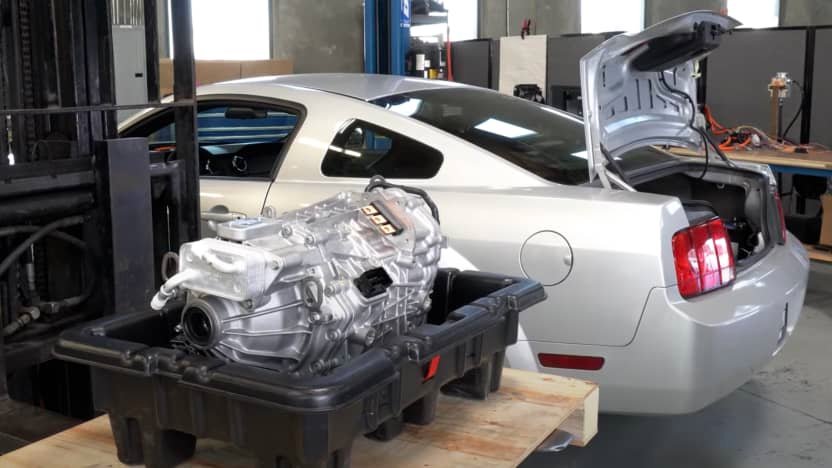
While Ford sells the Eliminator electric motor to US customers from $US3900 ($AU5560), the car giant currently doesn’t provide any accessories such as batteries, inverters, or engine control units (ECUs).
Fortunately, AEM specialises in ECUs and sourced the rest of the parts from various suppliers, which included batteries from tech giant LG Chem.
AEM used a Tesla subframe to fit the Eluminator electric motor between the rear axles of the Ford Mustang, allowing the coupe to remain rear-wheel-drive.
Ford’s global CEO Jim Farley shared AEM’s video of the Eluminator swap on social media platform Twitter, giving praise to the tuning company while hinting at accessories for the electric motor in the future.
The Eluminator motor has claimed outputs of 210kW and 430Nm. This equates to 38 per cent less power and 23 per cent less torque than the 5.0-litre V8 (339kW/556Nm) in today’s Ford Mustang.
Despite making less power and torque than its petrol-powered counterpart, AEM claims the Eluminator-swapped Ford Mustang does the 0 to 100km/h dash somewhere between five and six seconds, which is not much slower than the modern 5.0-litre V8 version.
AEM says the Eliminator is in need of a limited-slip differential – so it can deliver the power to both rear wheels rather than spinning the one wheel with the least resistance and losing traction.
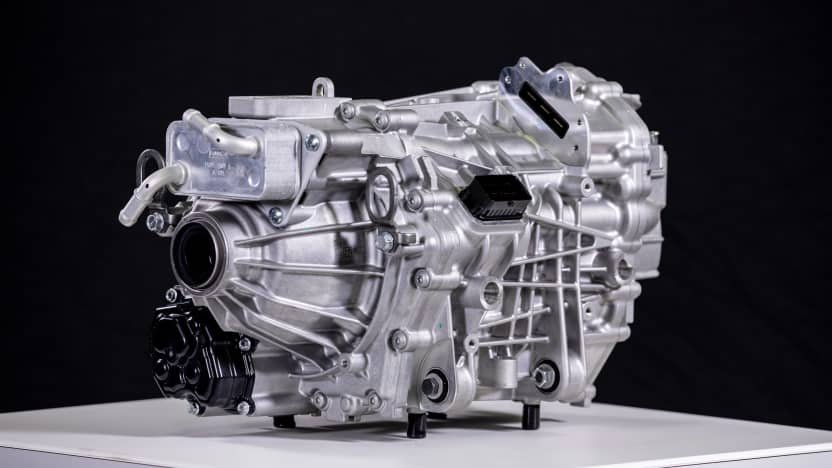
Ford Eluminator EV crate motor
Using components from the electric Chevrolet Bolt, the eCrate was installed in a 1977 Chevrolet Blazer, mounting up to the off-roader’s original four-speed automatic transmission and all-wheel-drive setup.
Neither Ford’s Eluminator or GM’s eCrate are currently available in Australia.

Read more about Jordan Mulach 
[bsa_pro_ad_space id=15]