
[bsa_pro_ad_space id=14]
- Doors and Seats

NA
- Engine

NA
- Engine Power

NA
- Fuel

NA
- Manufacturer

NA
- Transmission

NA
- Warranty

NA
- Ancap Safety

NA


 0
0As the competition for electric vehicles intensifies in an ever-expanding market, the new Nissan Ariya hits the mark in myriad ways.
- Eye-catching design
- Zen-like cabin aesthetic and roominess
- Refined and quiet on-road manners
- Uncertainty around Australian launch timing
- And uncertainty around local pricing
- Entry-level model’s 403km range could be a tad higher
Nissan really isn’t given enough credit for its pioneering spirit in the world of electric cars.
The Nissan Leaf, when it launched in 2010, was one of the first mass-produced electric cars from a mainstream manufacturer.
Some 600,000 global sales later and the Leaf, which remained the best-selling EV in the world until 2020 when it ceded its top spot to the Tesla Model 3, now has a big brother.
The Nissan Ariya (pronounced Aria, like the opera) is the latest electric car from the Japanese brand. And arguably one of its most important, slotting into the ultra-hot small to medium SUV segment.
Nissan Australia is still to confirm when we will see Ariya locally, if at all, but has stated repeatedly that it ‘would love’ to add the electric SUV to its local line-up. That’s a message reiterated again at last week’s international launch in Sweden, attended by Drive.
Certainly, the appetite for electric vehicles is increasing in Australia, and if buying trends are anything to go by, medium SUVs remain the sweet spot in any brand’s line-up. The Nissan Ariya fits the bill, then.
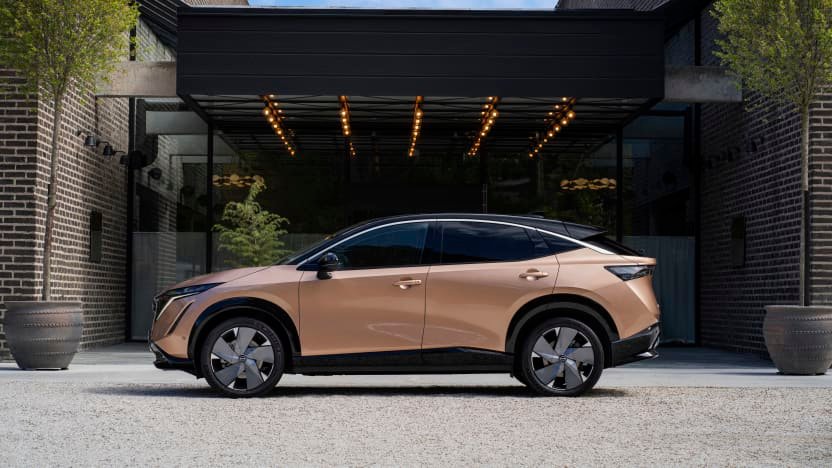
Let’s talk about the Ariya’s size. Nissan says it’s a compact SUV, but running the tape over its flanks and haunches reveals a different story. At 4595mm long, and with a width of 1850 while standing 1660mm tall, the Ariya is only fractionally smaller than the poster child of the medium SUV segment, Toyota’s RAV4 – by 20mm, 15mm and 30mm respectively. It is, by almost every measure, a medium SUV.
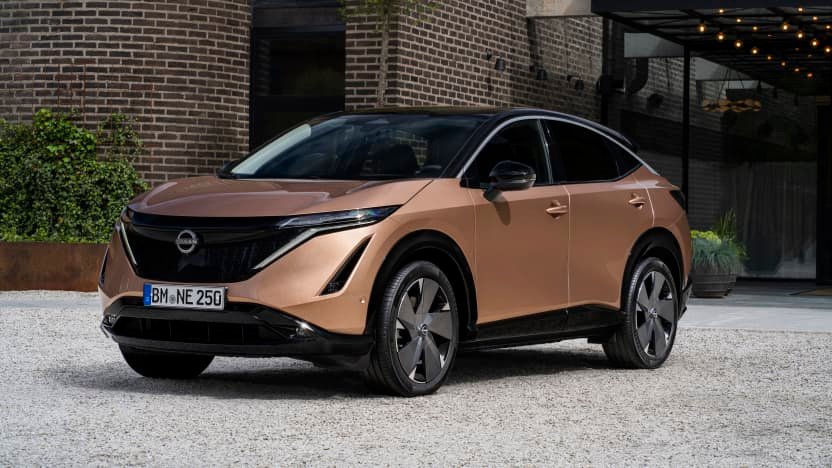
It certainly cuts a striking figure on the road, especially in our test car’s Akatsuki Copper two-tone paint, one of two hues exclusive to the Ariya (the other is arguably the even more gorgeous Aurora Green).
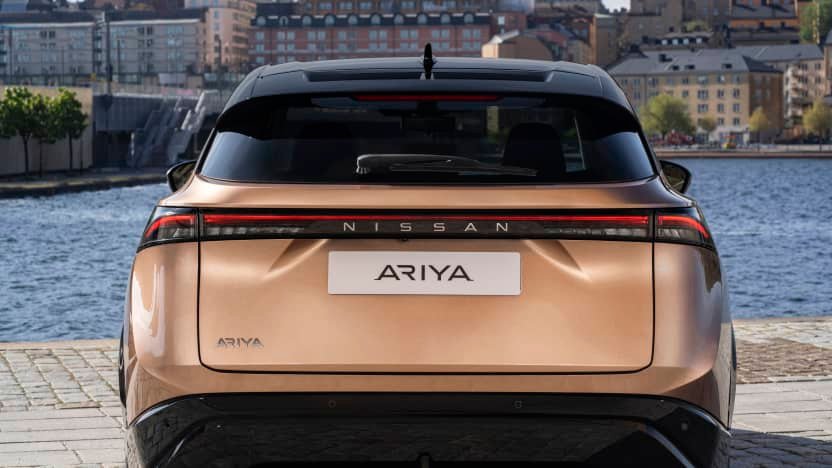
The design of the Ariya reflects Nissan’s ‘Japanese Futurism’ philosophy – sleek, seamless and confident. That’s a lot of marketing-speak, but there’s no denying the Ariya looks like an SUV from the not-too-distant future. Design, of course, is subjective, but to this reviewer’s eyes, and certainly in the metal, the Ariya looks sleek, modern and a little bit special while remaining unmistakably a Nissan.
| 2023 Nissan Ariya | |
| Seats | Five |
| Boot volume | 466L seats up |
| Length | 4595mm |
| Width | 1850mm |
| Height | 1660mm |
| Wheelbase | 2775mm |
That’s only enhanced inside, where the cabin is an exercise in light and space. Nissan says it’s adopted the ancient Japanese philosophy of Ma inside, the mastery of empty space. Space is in abundance.
From the straight-through floor in the front row to the clever sliding centre console that can free up space in the second row, especially notable for passengers in the middle seat, the Ariya feels light, it feels airy, it feels roomy.
Electric vehicles have pushed the boundaries of modern interior design, and the Ariya is no different. A minimalist layout combined with some interesting materials and textures lend the interior a fresh, contemporary aesthetic.
Highlights include the Scandi-style faux-wood strip running across the dash that features integrated haptic-touch buttons for climate controls and the like. Very modern, very tactile, very nice.
Even nicer are the Kumiko design flourishes found throughout the cabin. Kumiko is the ancient Japanese art of joining pieces of wood together without the use of nails or any other adhesives.
The clever joinery technique, perfected over centuries, makes for some interesting shapes and patterns, and it’s these Kumiko patterns that can be found throughout the Ariya’s cabin. Most notably in the ambient lighting system, which offers subtle yet effective illumination that looks lovely. It really does.
The second row is generously proportioned with genuine comfort for three across, thanks not only to the flat floor, but also that trick sliding centre console.
Other clever features include a large storage bin capable of holding tablets and the like, which slides out electronically from the dash at the push of a button.
Cargo capacity measures in at either 466L for the front-wheel-drive variants or 408L for all-wheel-drive models, the difference down to the AWD’s larger battery.
The Ariya’s infotainment set-up mirrors that of the new Nissan Qashqai hybrid we also sampled at the international launch. A 12.3-inch touchscreen with in-built sat-nav and Apple CarPlay/Android Auto smartphone mirroring is augmented by another 12.3-inch digital driver display that can be configured to taste.
It’s able to show a host of driving data, including energy consumption, battery charge and sat-nav. A crisp 10.0-inch colour head-up display that can also project driving data and route guidance onto the windscreen is just a bonus.
We drove just a single variant of the Nissan Ariya at the international launch in Stockholm, and it’s likely to be the most affordable of the three-model range. We don’t know, however, the Ariya’s pricing locally, or if indeed we will get the Ariya at all.
Nissan is, unsurprisingly, prioritising markets where EV take-up is high. And that means Europe, Japan and the US are at the top of the list, while Australia remains a low priority; a reflection of our slow uptake of electric cars.
Two front-wheel drive and a single all-wheel-drive model comprise the Ariya range.
The entry-level front-wheel-drive model is equipped with a 63kWh battery and a single electric motor at the front wheels. The motor is good for 160kW and 300Nm, helping to propel the Ariya from 0–100km/h in 7.5 seconds and a top speed of 160km/h. The 63kWh battery offers up to 403km of driving range based on the more realistic WLTP testing cycle. That’s probably marginally less than we would like to see on an entry-level model, but it’s also likely to be more than enough for most buyers’ needs.
A slightly more powerful 178kW/300Nm motor drives the front wheels in the mid-spec Ariya which, thanks to its larger 87kWh battery, offers up to 530km of driving range. Despite the more powerful electric motor, it’s actually slower to 100km/h, taking 7.6 seconds to reach the benchmark. That’s down to its bigger battery. More battery equals more weight equals slower acceleration.
The range-topping all-wheel-drive Ariya e-4orce (silly name: e-force, geddit?) is fitted with two electric motors, one at each axle, making a combined 225kW and 600Nm. The 0–100km/h dash is dispatched in a claimed 5.7 seconds, while its 87kWh battery provides 500km of range.
Charging times are a critical feature of EVs. The Nissan Ariya doesn’t disappoint. Our test car at launch – the entry-level 63kWh – can be replenished from 20 to 80 per cent battery – or 267km of range – capacity in just 28 minutes on a DC charger. Charging capacity is capped at 130kW.
A powerful home-installed wallbox with three-phase power and a capacity of 22kW will top up the 63kWh battery from 10–100 per cent in around 3.5 hours, while the more common single-phase 7.4kW home ’box offers a 10-hour charge to get from 10–100 per cent.
Of course, battery capacity and charging times are just two parts of the three-part EV equation. The other is how much energy does it actually consume in real-world driving conditions?
Nissan says the 63kWh two-wheel-drive variant we drove at launch will consume 17.6kWh per 100km. Our day behind the wheel through the many and varied conditions in and around Stockholm returned an indicated 17.0kWh/100km, better than Nissan’s claim.
Crucially, after covering 97.3km through city streets, rural back roads and Stockholm’s intricate motorway system, the Ariya’s ‘Drive Computer’ indicated we’d chewed through 79km of range. That’s a decent return on energy investment; an investment recouped via the Ariya’s e-Pedal regenerative braking system.
| Key details | 2023 Nissan Ariya |
| Engine | Single externally excited electric motor |
| Power | 160kW |
| Torque | 300Nm |
| Drive type | Front-wheel drive |
| Transmission | Single-speed automatic |
| Power to weight ratio | 84kW/t |
| Weight | 1950kg |
So, how does Nissan’s new electric vehicle actually drive? In a word, brilliantly. There’s a relaxed manner from behind the wheel, the Ariya feeling lighter than its circa 1800kg in this spec heft. Acceleration from standstill is pleasant, if not exactly thrilling, but then neither does it need to be.
Electric cars have focused on bold 0–100km/h sprint claims since going mainstream, and while headline-grabbing numbers titillate, they are a bit redundant in real-world traffic. Where the Ariya begins to hit its straps, and where the 300Nm of torque comes into its own, is accelerating on the move. The surge in speed from, say, 60km/h to 100km/h, is scintillating, the Ariya simply leaping ahead with abandon. Overtaking has never been so easy.
Easy is a word that sums up the overall driving experience. It is just so easy from behind the wheel – it’s quiet and refined, fast enough when you need it to be, and relaxed when you want.
The quietude extends to the Ariya’s excellent suspension set-up – MacPherson struts up front and multi-link independent at rear, for those who like to know such things – which does a superb job of not only soaking up bumps and lumps, but also keeping things quiet inside the cabin. Nissan’s sound-deadening efforts help here too.
Our test loop included some tempting stretches of twisting back roads; a perfect canvas for gauging the Ariya’s dynamic capabilities. Thanks to its low centre of gravity (the hefty batteries are packed flat under the floor), the Ariya remained flat and taut during some more adventurous driving.
The steering felt nicely weighted, too, offering nice resistance without being overly heavy. This is intentional, according to Nissan, with customer feedback specifically from Leaf owners highlighting the electric hatchback’s steering was too light (true!).
The result is an SUV that feels connected to the road and solid, while remaining serene inside. Just like an electric vehicle should be.
There are minor quibbles, of course. While the second row is commodious and comfortable, we did find toe room a little on the tight side, but we’re really clutching at straws.
Sales of electric vehicles are booming in Australia while the clamour of medium SUVs of all persuasions continues apace. If Nissan Australia can secure a supply for its newest EV, it should land straight into the sweet spot of buyer sentiment.
Price will be key. There’s an increasing armada of electric vehicles from mainstream manufacturers lobbing locally in the $65–$80K range. If Nissan can come in around that, or even under, then the Ariya should be a winner.
Read more about Rob Margeit 
[bsa_pro_ad_space id=15]