
[bsa_pro_ad_space id=14]
W.O. Bentley, founder of the eponymous 102-year-old automaker, once proclaimed, “I have always wanted to produce a dead silent 100 mph car, and now I think that we have done it.” He was, of course, referring to the 1930 Bentley 8 Litre at the time, but the comment was more prescient than he could have realized now that the marque has recently climbed the next rung on its ladder to electrification with the 536 hp Bentley Flying Spur Hybrid.
The move to hybridization and, soon, zero-emission vehicles altogether is part of Bentley’s “Beyond 100” plan announced in 2020, which mandates a complete discontinuation of the internal combustion engine (ICE) in the next eight years. The second model in the lineup to go plug-in, following the Bentayga Hybrid, this Flying Spur heralds from a prestigious lineage that began in the 1950s with the Mulliner-dressed S1 Continental Flying Spur initially powered by a 4.9-liter straight-six engine. Subsequent iterations carried a V-8 power plant up until production ended in 1965. With the new century came a new lease on life, and the moniker was reborn in 2005 with a W-12 engine and, later, was completely revised for the 2019 model year.
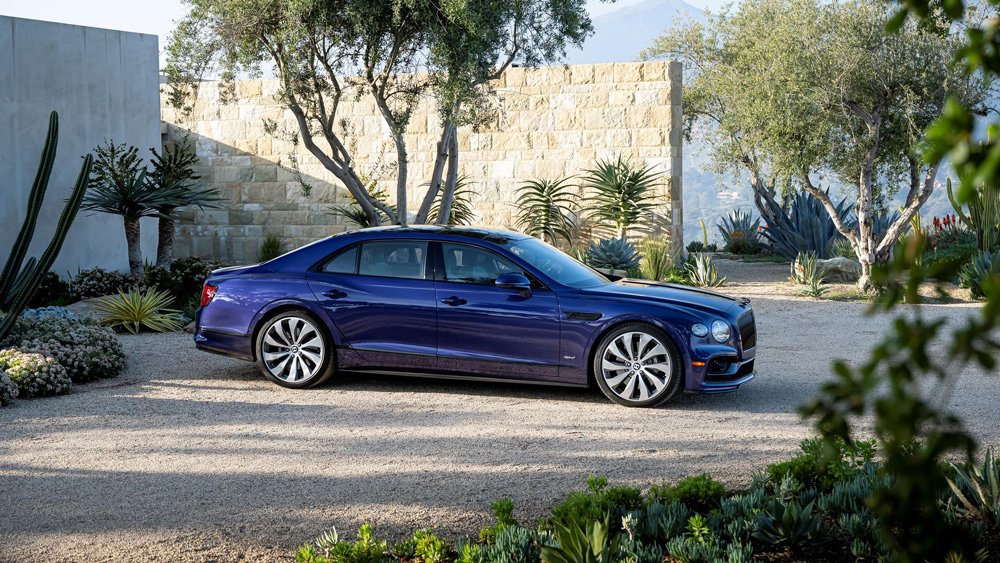
Bentley’s Flying Spur Hybrid in Azure Purple.
Photo by James Lipman, courtesy of Bentley Motors Limited.
The backstory puts in context how pivotal this hybrid version, starting at $210,000, is for Bentley’s future direction. Pulling away from the Peninsula Beverly Hills, in Los Angeles, I am more than curious to see how our battery-enhanced Flying Spur, decked in lustrous Azure Purple garb, measures up to a direct competitor like the redesigned Rolls-Royce Ghost or even a lower-price-point sedan like the Mercedes-Benz S-Class. Also of interest is the level of sacrifice in performance, if any, when compared to Bentley’s current ICE-powered lineup.
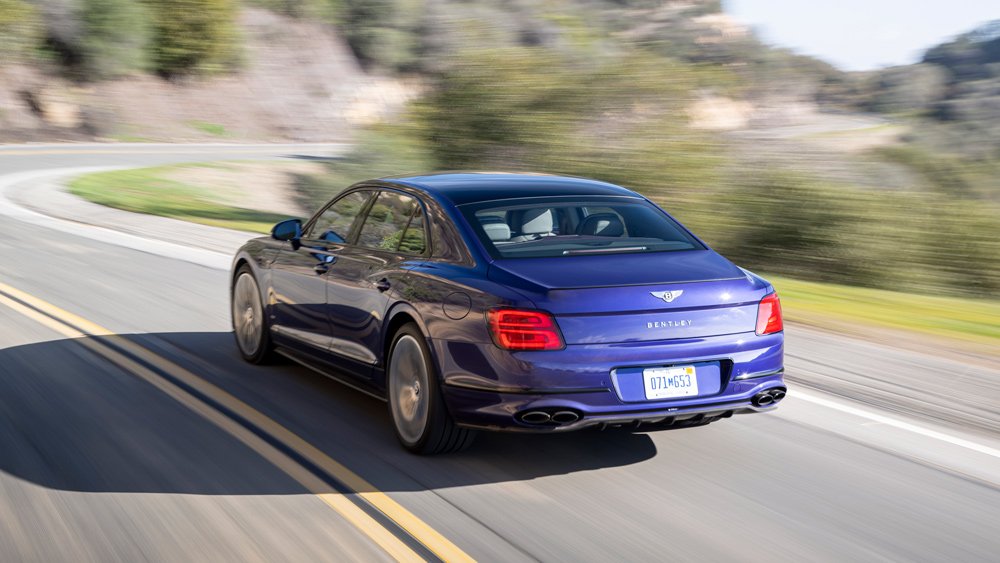
With its fully charged 1.4 kWh lithium-ion battery and a tank of fuel, the car has nearly a 435-mile range.
Photo by James Lipman, courtesy of Bentley Motors Limited.
Navigating through the City of Angels and onto the 101 Freeway, the Flying Spur works with the navigation system to nimbly dance between the three E Modes, or battery-management settings, including EV Drive, Hybrid Mode and Hold Mode. During urban sections, EV Drive emphasizes the 134 hp electric motor—given juice by a 1.4 kWh lithium-ion battery—while the Hybrid selection optimizes use of both the latter and V-6 for extended travel without my awareness of any alterations between the two. Its only in Hold Mode, designed to conserve battery charge, say, when in Sport, that the 2.9-liter V-6 becomes dominant. In all, the hybrid configuration is claimed to be good for a nearly 435-mile range.
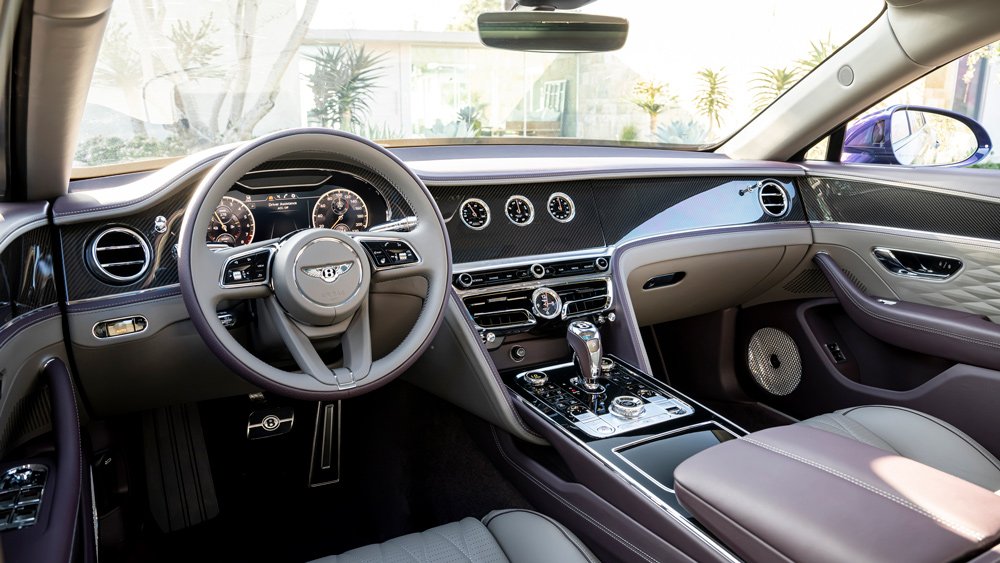
The hybrid version of the Flying Spur still sports the same sumptuous cabin that earned Robb Report’s Best of the Best accolade for interiors last year.
Photo by James Lipman, courtesy of Bentley Motors Limited.
But why a V-6? That’s a question I posed to Steve Jones, Bentley’s chief technical engineer for the Continental GT, GTC and Flying Spur. His response was diplomatic while avoiding any acknowledgement of shared platforms within the Volkswagen Group, mentioning that “the only available power train for that particular car is the V-6 PZEV engine.” Jones, however, was candid in what he thought the greatest challenge was with this model variant. “Our customers expect effortless power delivery, and of course that’s easy to do with a W-12 engine that’s capable of 650 bhp and 950 Nm of torque.” He goes on to mention that “the V-6 is obviously a much lower power derivative, but by combining it with the e-motor, we can deliver an equivalent power output as that of our current V-8,” and adds that he’s “particularly proud that we’ve taken a six-cylinder engine and delivered a credible power-train offering.”
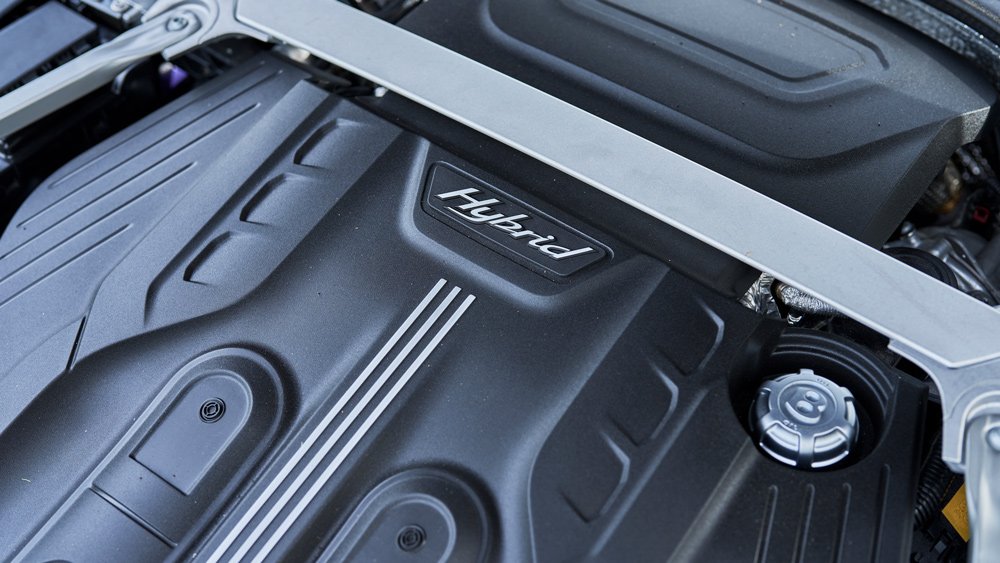
The 2.9-liter V-6 and electric motor combine for 536 hp and 553 ft lbs of torque.
Photo by Kelly Serfoss, courtesy of Bentley Motors Limited.
“Credible” is an accurate descriptor for the overall drive experience, as it’s certainly not incredible, which is close to what is presented by the Bentley Continental GT and Rolls-Royce Black Badge Ghost, in my opinion. Tracing circuitous State Route 150 around Lake Casitas to Ojai, just south of Santa Barbara, I switch from Bentley mode (the comfort setting) to Sport and briefly hammer the throttle to tap into the 553 ft lbs of torque. I’m met with acceleration akin to a winded sprinter straining for the finish line as the engine seemed to grasp for the next gear, at least compared to the Usain Bolt–like Continental.
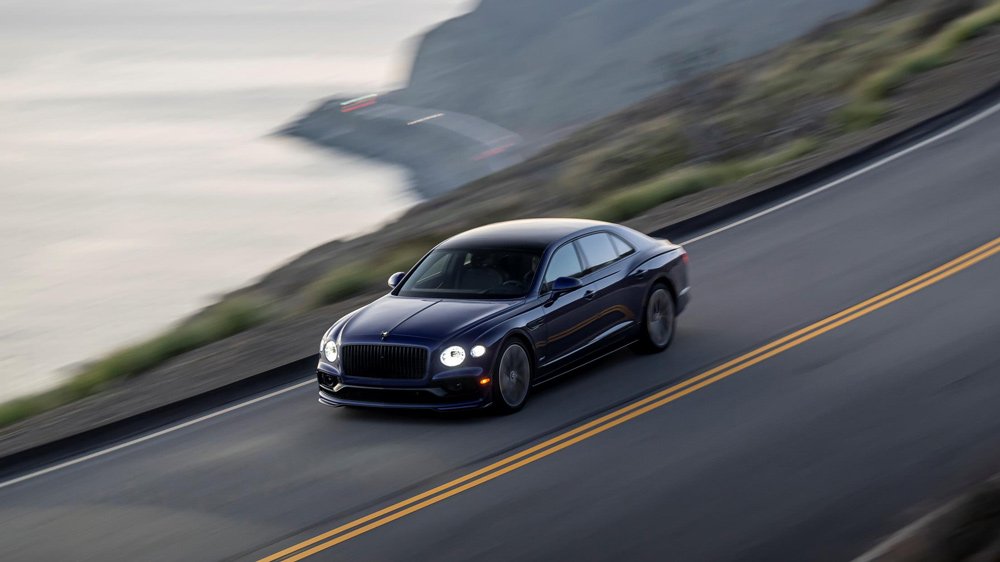
Exploring one of Malibu’s canyon roads at dusk.
Photo by James Lipman, courtesy of Bentley Motors Limited.
On the turns, the 5,523-pound (curb weight) all-wheel-drive four-door doesn’t hide its heft as much as expected, and I found that the presence of all-wheel steering is not as immediately apparent as it is with the Mercedes S-Class. Still, the machine covers zero to 60 mph in 4.1 seconds and tops out at 177 mph, certainly no slouch. It’s not that engineering is lacking, far from it. The chassis benefits from double-wishbone suspension at the front and a multi-link setup at the rear, along with three-chamber air springs that are claimed to provide 60 percent more volume than before. And stopping prowess is owed to what Bentley touts as “the largest iron brakes in the world” at 16.5 inches in diameter. The bottom line seems to be that the Flying Spur Hybrid lacks enough muscle for its mass. It’s like a thoroughbred foal, the impressive shape and potential for athleticism is evident, it just hasn’t fully come into its own yet.
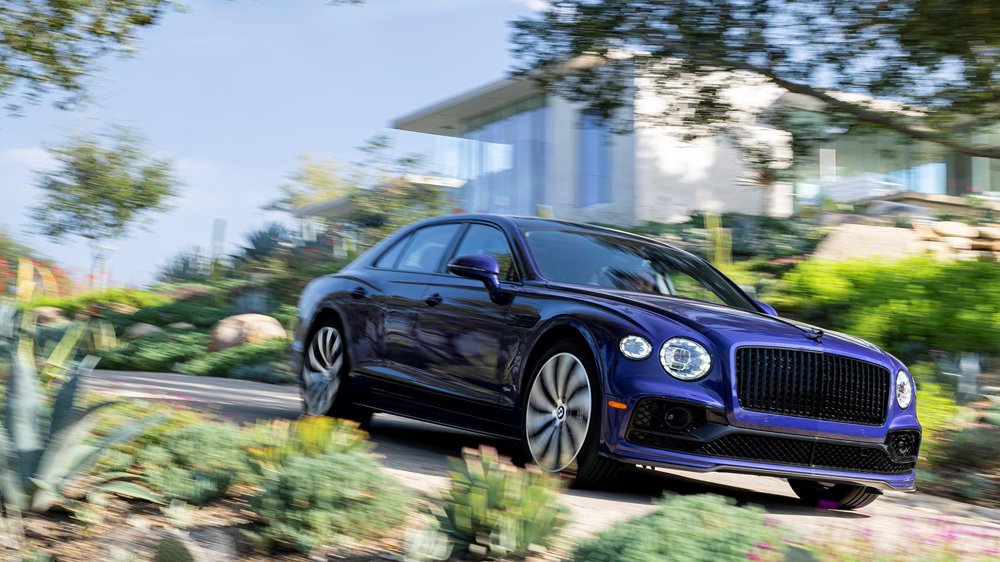
The all-wheel-drive four-door has a curb weight of 5,523 pounds.
Photo by James Lipman, courtesy of Bentley Motors Limited.
As to aesthetics, though, the model certainly belongs in the winner’s circle. The wheelbase’s 5.11-inch extension and our example’s optional 22-inch wheels (in Mulliner spec) add to the gravitas of both the car’s silhouette and stance, as does the newly illuminated Flying B hood ornament. But to be expected, it’s the Flying Spur’s interior that truly charges the senses, which is why it was named Robb Report’s Best of the Best in that category last year. From unseen details like the knurled surface treatment behind the door handles to the innovative rotating dashboard display to the 3-D diamond-quilted door and panel inserts, the hybrid still has it all.
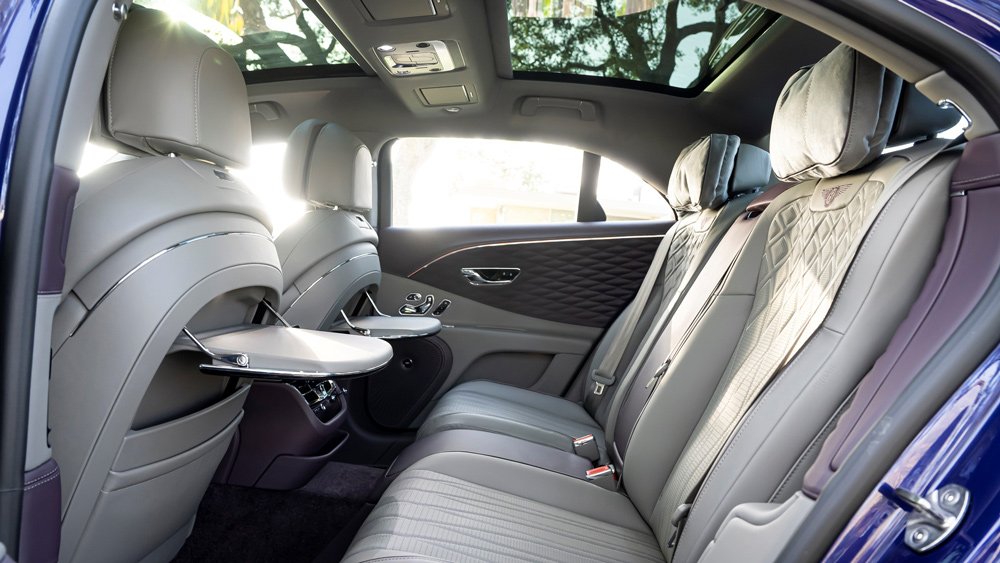
Our Azure Purple example’s inner sanctum is defined by Damson and Porpoise leather as well as 3-D diamond-quilted upholstery and paneling.
Photo by James Lipman, courtesy of Bentley Motors Limited.
When asked what he anticipates the demand will be for the Flying Spur Hybrid in relation to the US market, Christophe Georges, president and CEO of Bentley Americas, answers pragmatically. “Hybrid in America, for Bentley, is obviously quite new,” he notes. “They [customers] need to try it, to test it, and then we will be able to assess what will be the share. But if you look at the overall market for hybrid, it has developed considerably last year in America, so we should see the same kind of development happen with us; maybe it’s not the same proportions, but we’ll see.”
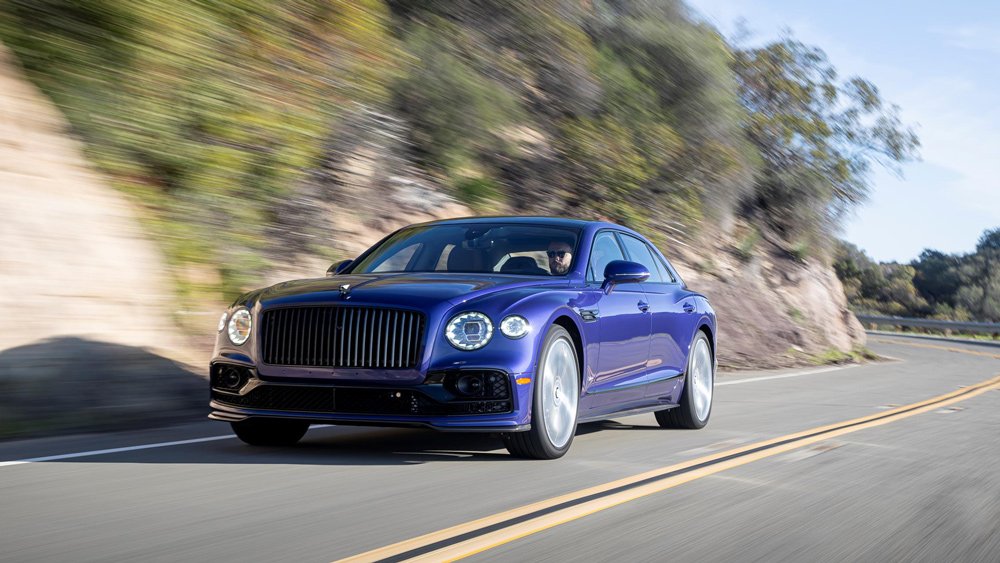
Pricing for the model variant starts at $210,000.
Photo by James Lipman, courtesy of Bentley Motors Limited.
After spending time behind the wheel, I find Georges’ expectations to be realistically tempered. The Flying Spur Hybrid, while offering as baronial a passenger experience as any Bentley, is nonetheless a beautifully appointed stopgap. But perhaps such interim status is where its true value lies—a promising future collectible poised to mark the most important transformation in automotive history.
[bsa_pro_ad_space id=15]