
[bsa_pro_ad_space id=14]
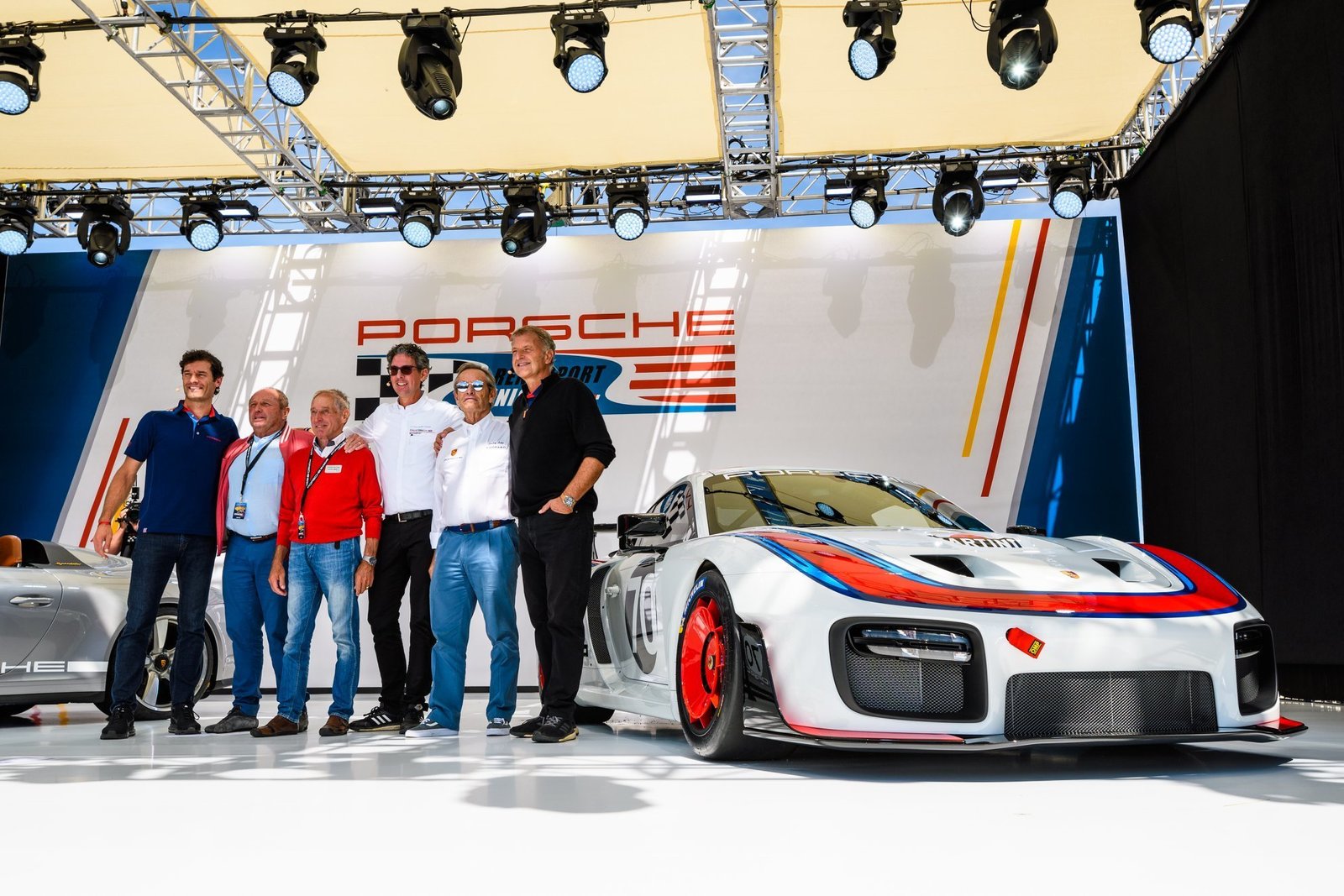
The year-long celebration of Porsche’s 70th birthday is just that! When we thought Porsche couldn’t possibly pop up with a new car to celebrate its birthday, after debuting the 919 ’Tribute’ and the 911 (993) ’Project Gold,’ the Germans decided to surprise everyone with a 935 for the modern age that was presented at Laguna Seca.
“This spectacular car is a birthday present from Porsche Motorsport to fans all over the world,” said Dr. Frank-Steffen Walliser, Vice President Motorsport and GT Cars for Porsche AG, upon unveiling this sci-fi-meets-retro-cool creation. “Because the car isn’t homologated for any series, engineers and designers didn’t have to follow the usual rules and thus had freedom in the development.” Naturally, no place else was better to show off this limited-edition car – only 77 will be made – than at Weathertech Raceway Laguna Seca during the Rennsport Reunion VI weekend.
Indeed, what we see here doesn’t resemble anything from Porsche’s current fleet of race cars, or road cars for that matter, but it was strongly inspired by a car from Porsche’s past. The inspiration is the 40-year-old Porsche 935/78 known as ’Moby Dick’ for its extra-long rear tail section, which raced only four times in 1978 but its legacy lives to this day.
The original 935, unlike this new model based on the Porsche 911 (991) GT2 RS, was built out of necessity. Porsche needed a car to compete in the new-for-1976 Group 5 rulebook that was introduced in the World Championship for Makes to attract manufacturer interest as the prototype car counts were at an all-time low.
The rulebook allowed for groundbreaking modifications to be done to the bodywork, as long as the roofline, windows, and doors were those of the production 911. With this freedom in mind, Porsche ditched the twin-headlight setup for a slant-nose front end with obvious aerodynamic gains. The widebody that resulted, coupled with the flat-six 2.9-liter engine from the 930, ensured that Porsche was the leader of the pack in 1976 and beyond.
Constant development work saw Porsche roll a new model in 1977, known as the 935/77 and a new one again for 1978, the 935/78, as well as working to benefit customers by updating its original 1976 design and offering it to private racing outfits under the 935/77A, 935/78A, and 935/79 designations.
The cars were so successful that they just about defined what Group 5 was all about: ludicrous silhouette bodywork, immense firepower from the engines – up to 700-horsepower for the later versions – and amazing speeds. Under various guises, the 935 won the 12 Hours of Sebring multiple times, the 24 Hours of Daytona multiple times, the 24 Hours of Le Mans once in the overall classification, and the World Championship for Makes for four years in a row.
A few of the aforementioned privateer outfits, due to their close affiliation with the factory, were allowed to modify the 935 further, according to their own plans. That’s how the Kremer-developed cars were born, as well as those constructed by Joest Racing, Fabcar or AIR. In fact, the Porsche 935 that won at Le Mans in 1979 wasn’t a works entry, Porsche dropping the Group 5 program after it retired the 935/78 from competition, but a privateer one from Kremer Racing with their own 935 K3 which was probably more celebrated in its day than the factory-developed cars.
All these victories, and Porsche’s improvements of its turbocharging technology which led to their domination of Group C in the ’80s, grant the 935 a spot in Porsche’s gallery of legends. It is, then, easy to see why the engineers in Zuffenhausen built this rolling tribute that is the 935 Type 991 Generation 2. This also means that the hype is big and, although it’s not homologated for any racing series, the new 935 has to live up to its predecessors on the race track. That’s why Porsche chose to unveil the car at the Rennsport Reunion VI.
Keep reading to find out more about the 935 Type 991 Gen. 2
[bsa_pro_ad_space id=15]